Showing posts with label Dungeons & Dragons. Show all posts

Wednesday, 29 April 2020

Old RPG Words That Make No Sense

Progress in RPG design and play is held back by the words we use that don't make any sense.

Hit Points.

So many RPGs have some version of "hit points" whether it's called hits, hit points, health, vitality, or whatever, it is expressed as a representation of how much damage a character can take. Video games have copied this idea for years, and you see your little digital bonhomme getting wailed on while a bar or a number  of hit points gets smaller. Why not? It's there in the name, right? Hit points, those are points you use up getting hit, right?

Someone is hoping the undead giant is almost out of hit points

Except it's not right. Not really. Hit points have almost always been an abstraction expressing something else entirely. I've talked about the problem of damage before, but in terms of Dungeons & Dragons and many games using hit points, there is no damage until the hit points are gone. Hit points represent the ability of a character to postpone the inevitable through skill, experience, luck, or script immunity. They represent an ability for a hero to keep fighting when everyone else would be done. They are more a measure of endurance than damage capacity.

This idea is further confused by the old-school rates of healing where characters only got one hit point back per day of resting. Something ridiculous when characters can easily get to a place where they have 20 or 30 hit points. If they are healing, then they must have been hurt, right? Except that is not how it works. A character is just as effective at one hit point as they are at full hit points. Because they are not hurt unless they are at zero! In the old days if your character went below zero they were dead! Not just wounded, but killed. Luck finally caught up with them and took her due. It wasn't long before rules developed for going into negatives where a risk was involved, but not immediate death.

Fast forward to the last few years. Two different innovations double down on the idea of hit points as an abstract that expresses endurance. The first is the death and dismemberment tables that came out of the Old School Renaissance (OSR) Blogs. The idea was if your character went below zero hit points they had been wounded and could be badly hurt or even dead. Rolling on the tables got you a result that your character had to live with. Maybe they lost a limb, or an eye, and it had ongoing mechanical effect on the character. After a while they could look pretty rough. Eventually a character could even be forced into retirement by accumulating too many, "old war wounds." I'm a big fan of the death and dismemberment tables. Partially because they reinforce the concept of how things work, but also because they add a real element of risk to fighting to your last. Players with characters who can be brought around in a moment to fighting condition with no consequence are not going to have any good reason to surrender, if there is no consequence to negative hit points. The idea that the table might give them a reason to play as if getting wounded is something to be afraid of encourages more realistic role playing.

Oops! You interrupted her short rest.
What's the worst that could happen?

The other innovation is the idea of short and long rests. I think the first game I saw this idea in was Barbarians of Lemuria, where a few hit points could be recovered by taking a breather and a quick drink and full recovery required night's rest. This same approach made it into a few different small press games, and the latest edition (the so-called 5th edition) of D&D. By explicitly recovering hit points through short and long rests the D&D, and any other RPG, rules are making hit points endurance. There is nothing wrong with this approach. I like it. It's cinematic and makes for high-speed pulp-fiction action! That's all great! It allows players to accomplish more by giving them more significant choices about how they use the two resources they have, time and hit points.

The problem is the thing is still called, "hit points," and we generate them by rolling, "hit dice," when these two things are expressions of endurance. It doesn't really matter where the name hit point came from. It may be a hold-over from the war games the designers of the early versions of D&D were playing and using to inform their first RPGs. Maybe someone thought it sounded cool. The fact is, it doesn't fit and is actually misleading. All the grognards and legacy players are already composing their comments about how wrong I am and how the word doesn't matter because obviously we all know what it means.

Except we don't. Many players think the fast recovery of hit points through rest is unrealistic because you can't walk of a sword thrust to the abdomen. If we expressed it as endurance and described combat with point loss as close calls, bangs, jams, bruises, and numbness in the limbs it would be easier to get more people all in on the concept. The other problem is new players. RPGs have exploded, in no small part to the efforts of Wizards of the Coast to make D&D accessible and easy to grasp. Words like hit points get in the way of that because they suggest the character is getting hit when they lose hit points. Why set them up to fail? Why not call it what it is? Because of tradition? Meh, there are more new players now than ever before. Because someone can tell them? People are learning to play from the books and watching actual play on you tube. Terms matter in both of these cases because that is how the new players will interpret what is happening in the game. I'm not the first to come to this conclusion. The Neo-Classical Geek Revival (NGR) fantasy RPG has used the term "Luck" for these points for years.

Someone is rolling on the death and dismemberment table!

The waters are muddied further by the idea of weapon damage. When D&D was first created, almost everything on two legs had single digit hit points. Humans were all assumed to be zero level with, at most, three hit points. That means that first hit was probably taking them down. A dagger could do it, but a two-handed sword had a better chance of ending a generic cultist or town guard in one shot. Fighting fantastic monsters the assumption was they were magical or huge beasts that could actually be hit more than once with little effect. Calling it hit points under those circumstances could have made sense to the people running and playing those first games. It might even still make sense to call the ability of a dragon to keep fighting hit points now. I'll concede that point. Still, for the sake of having a consistent expression it is better to have magical creatures with endurance than characters with hit points for the reasons I outlined above.

So if a weapon doesn't do damage to a character, what does it do? The way I run it at my table is attacks remove hit points. no one takes damage until they go down. Monsters snarl in pain at flesh wounds, enemy shields buckle under the assault, or they are beaten back as they lose their hit points. I've run it like that for a couple of years now. For example, "Your shield arm is still vibrating from the blow and you lose (rattle-rattle) four hit points." It seems cleaner to move this to something like, "Sparks fly as the bugbear's axe crashes against your sword and you stumble back a step. You lose (rattle-rattle) 7 endurance."

It's visceral, it keeps everyone in the fiction, and it shows the player what they still have in the tank to finish the fight. Then they choose how far to take it. Can they push through and find a place to hole up for long enough to get their wind back? Has the alarm gone up and they are facing a running fight until they can win or get out? Endurance is no less exciting, or dangerous with the addition of a death and dismemberment table. It's also still all close enough that converting old modules and third party adventures on the fly should be no problem for a referee/game master.

I run a hugely modified version of the original Black Hack rules. I call the threat to endurance, "attack dice," and it seems to work well. The attack die represents the combat ability of a given character or monster when they attack. It's logical, accurate, and it works well in play. I like to run for new people and experienced players alike. Everyone seems to like it so far.

Belkar Bitterleaf, of the Order of the Stick

These old words, hit points, have the baggage of old assumptions based on their wargaming routes and new assumptions based on what the words mean. For ease of adoption of current gamers, the words are used. They are a short hand that no one will question. Because no one questions the short hard, the baggage follows us to new games that arguably, would be better off without them. There are a host of D&D clones and D&D-ish games out there thanks to the Open Gaming License. These new and different games all put some kind of a spin on the tabletop RPG experience. The publishers of D&D might fear losing their current base by changing too much, but small press publishers have more freedom to break new ground. That's why most of the best innovations in game mechanics, campaign settings and game art come from the small press publishers.

If we take advantage of this freedom, and we dump hit points, hit dice, and damage, what is next? What other words make no sense? Levels, maybe? There are character class levels, spell levels, dungeon levels... How many different things do we need to describe with the same word?

Character level seems sacrosanct. The concept of leveling up is ingrained in western culture thanks to video games borrowing their framework from D&D.  If characters get levels, then everything else needs to find a better word.

Dungeons could be described in terms of floors: Floor one, two, etc. That makes sense and translates well enough to real experience. I don't go to an office on the fifth level of the building, I go to the fifth floor. This seems easy enough to change and will not make it more confusing, at least.

When we talk about spells, we are talking about power. Each level a magic wielding character ascends gives them access to more spell casting power. If spells were described in terms of power, it would make more sense for a level five wizard to finally gain access to power three spells like fireball! Power one, power two... or is it first power spells, second power spells, etc? Regardless, power is a suitable replacement.

As designers and runners of games, many of us do our best to trim the fat of game mechanics so our games run fast and smooth. We should be doing the same with the terminology. If we don't we are leaving a barrier in place for no reason other than that's the way it has always been done without asking if it's the best way to do it.

I'll be trying these out in in my home game and any D&D type games I run online this summer. I'll see how it works out. If you try it, let me know how it works for you. Does it change anything?

What?
I have the Warrior Princess Prestige Class so these arrows used up temporary hit points.
I'm still at full HP!

Tuesday, 22 May 2018

Review: UVG - the Ultraviolet Grasslands and the Black City

With all the awesome things released this year it blows my mind that one I will use first is both free and, according to its author, incomplete.

Luka Rejec released an introductory version of the "Ultraviolet Grasslands and the Black City" last week. It's a 78 page point crawl with only one location fleshed out. According to Luka's Patreon, the complete version will be released in August of this year. While I'm looking forward to it, this teaser version has plenty to offer.

The cover by Luka Rejec


At long last, WONDER!

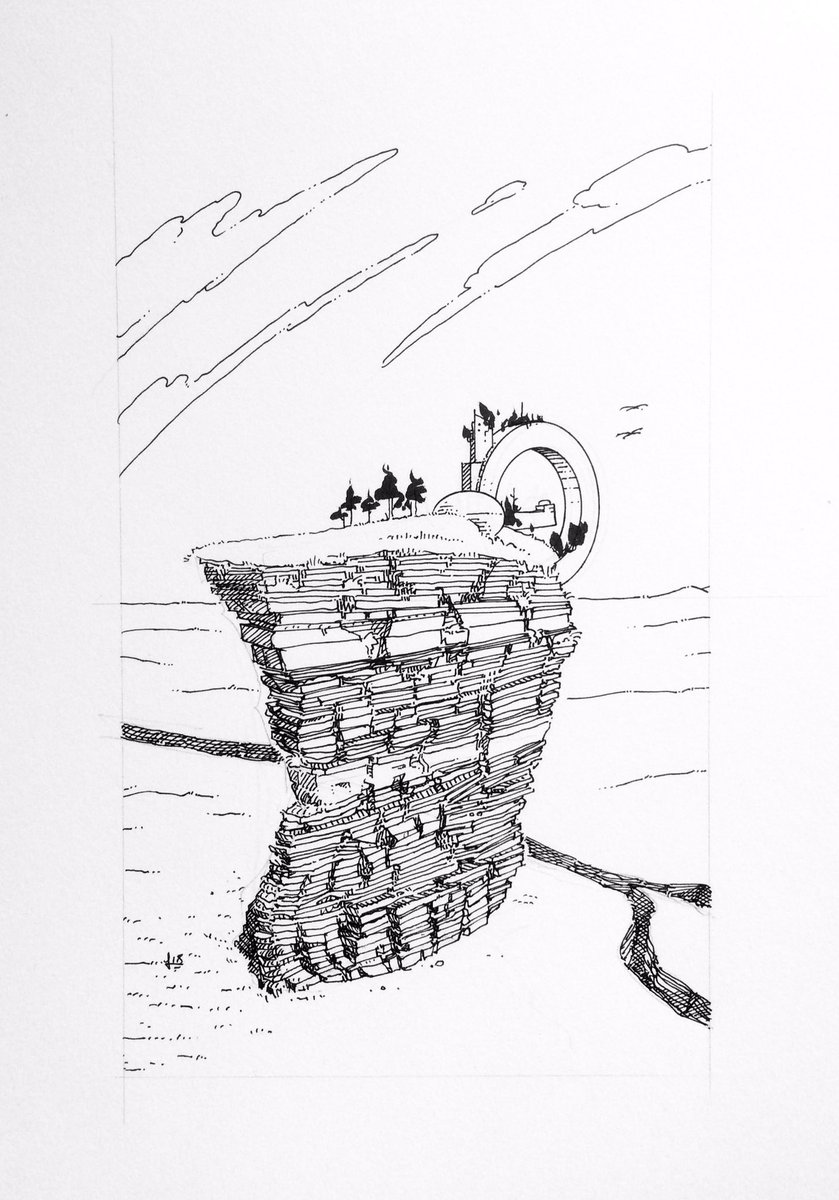
I downloaded UVG for the artwork. Luka's work has a way of expressing a great deal of detail and movement with a few simple lines. It reminds of the work of Jean Giraud, A.K.A. Moebius, while showing me something new and original. His work carries a sense of wonder and the fantastic while not settling in any particular genre. I am a fan.

"The Rusty Arc" by Luka Rejec

The Ultraviolet Grasslands leans into this same aesthetic. Luka is is upfront about the influence of the Dying Earth and psychedelic heavy metal on the setting/adventure. The sense of an ancient world, full of sorcery and super-science haunted by the, "long ago," is carried through the adventure's descriptions of the rotting technological remains, strange locations and local inhabitants. 

The new creatures and cultures introduced by the book add to the strangeness with a light touch. Each group, from humans to para-humans, has a brief description and then a table of rumours you can build your campaign's version of them from. Randomly generating the true and false features of these para-humans helps preserve that sense of uncertainty in the unknown and doubles down on the exploration theme of a fantasy RPG. It reminds me a bit of how Traveller's 76 Patrons was set up with a single premise or set of characters with multiple details on a table under each. It allows for the whole thing to be used more than once and be surprising for both the referee and the players.

UVG captures the wonder that the small press RPG community seems to be reaching for recently. It is exactly what I've been looking for. Judging by the sudden addition of Patreons since last week's release, I'm not alone.

"Tower and Hill" by Luka Rejec


Innovation!

It seems like almost every notable small press RPG release from the DIY D&D and OSR communities has some sort of game-changing innovation. UVG certainly delivers in this area. Luka created some new rules for travel which simplify encumbrance and travel while still making them work in a new way. His ambition was to convey both the vast size of the adventure area and the danger of travel through his weird savanna. I'll know for sure once I incorporate it into my regular game, but from reading it, I'd say he succeeds. Besides that success, he also creates a rules-light system for speculative trade that reminds me of Classic Traveller. The simplicity of Luka's system gives the players real choices about how much cargo to carry versus supplies, how large to make their caravan, and even what form of transport and retainers to use. All of these choices have an impact on the speed of travel, potential for encounters and even the likelihood of starving to death. Things like caravan speed and visibility also change the chances of starving and having an encounter.

Hacking up Treasure for UVG - Luka Rejec

I like the switch from days as a unit of time for travel to weeks. It helps to create the sense of isolation in the wilderness when there is only one encounter rolled per week. The party is on its own so they better have what they need. 

Because space and weight are issues that can kill a party, treasure can't always be hauled away with ease. Because of this feature, there are rules for hacking up the treasure for the best bits. This form of looting does terrible damage to these finds, turning the party into vandals, but it allows them to make choices about how they want to deal with large pieces of treasure.

While the UVG is a sandbox filled with all kinds of creatures and points of interest, the distance is the biggest enemy that needs to be faced. I enjoy this feeling of the vast openness as an opponent and can do a lot with it. It certainly marks this adventure as something special and reminds me a bit of how the darkness is handled in Veins of the Earth.

I like how once there is trouble, or something to explore, we return to shorter time units, from days for starvation, down to seconds for combat. It's a way of narrowing the focus and placing the players into the context of the current size of the environment they are interacting with. I'm looking forward to saying things like: "Four days into the second week you see movement on the horizon..."

Luka Rejec's Caravan Record Sheet for UVG makes tracking the new important bits easier!


How does it work?

Luka describes it as a rules-light, RPG point crawl and it is that, but it is clearly set up with some version of 5th edition D&D in mind. The saves reference the six classic statistics. Also the rolls for success use a roll high verses a ladder of target numbers. 

I tend to run a heavily modified hack of the Black Hack so the stat-based saves fit in fine, but the progressive target numbers are a bit harder to work with if you aren't using a skill system. The easiest thing seems to be dividing the stat by three and adding it to the d20 roll, but the most accurate might be to compare how much the check against a stat is made or missed by to the target number ladder. Someone using LotFP might want to multiply skill pips by two and add that amount to the d20 roll.

Despite the few 5e-isms built into the system most things are designed for cross compatibility. Encumbrance and movement rates are simplified when translated into a weekly turn system. All prices are in "cash" so it doesn't matter if you are using a gold piece, silver piece, or tic-tac as the main currency. All the creature and transport descriptions are expressed in terms of hit dice so they will work with any of the D&D editions or clones with minimal work. The weird weapons and items work with minimal conversion as well. 

Another Point of Interest in UVG - Luka Rejec

Basically the innovations are rules light and completely compatible with any system, while the details like weird weapons and armour are mostly expressed in terms of the 5e D&D rules with ascending AC for the armours and weapon terms such as, "finesse," and, "versatile." Any DM/referee using a stripped down "O5R" style rules will not need to convert anything. For the rest, it can be converted or ignored as usual.

The point crawl itself has a series of destinations arranged on the map with the different routes between them marked in how many weeks it usually takes to travel them. There are also spots for placing or generating, "points of interest," near the destinations or off the routes that the party might want to spend some time investigating. These points of interest are investigated in days instead of weeks. There is one sample, but no random generator for the points of interest. You'll need to create those on your own. I expect the full version will have more.

In this introductory version of the UVG, only the first destination, the Violet City is fleshed out. The rest are given a paragraph of description that is enough for anyone looking for inspiration, but leaves a lot of work for the referee to detail. The other locations are available to Luka's Patreon contributors up to #22, The Cage Run, but more are being added all the time. I like it as is. The paragraphs give me enough to work with that I can add details on the fly or make a few tables to generate some points of interest. I might even cannibalize LotFP's Carcosa for some points of interest and other terrors left over from the, "long ago." 

Point of interest from the "Long Ago" - Luka Rejec


UVG! What is it good for?

The sandbox can be used whole hog as described in the adventure and there are plenty of hooks to entice a wide variety of players to enter the Ultraviolet Grasslands. That's my plan.

The rules for hacking up parts of treasure for encumbrance reasons are going to be part of my campaign from the next session onward! 

UVG's rules for overland travel through what is essentially a desert are great! I'll be rolling those into my normal game for long distance travel. The simplicity and presentation of important choices to the players are the perfect tool for me. I may make some modifications for water-based travel so I can keep everything consistent. A new obstacles table is the first thing to create, but the UVG one is a great model!

The rules for trade and even market research could be used in a seafaring campaign or other trade-based adventure. If you spent a long time creating a vast world full of vibrant detail, or you spent a lot of money on supplements of the same, the trade and travel system might be a way to get the party moving around the map so you can use more of it. 

The Para-humans of the different factions in the UVG can easily be lifted and dropped into any fantasy world. There's no reason why the Cat Lords or Porcelain Princes can't be secretly be in charge of Vornhiem, Calimport, Lankhmar, or any home brewed city. 

The art is fantastic and could inspire a kick-ass campaign on its own! Knowing that the art would be awesome is a big part of why I took the time to check this intro UVG out! Without it, I might have waited for the finished product.

Final Thoughts

For a teaser product, the intro version of the Ultraviolet Grasslands is surprisingly complete and usable. The table of contents makes it easy to find specific information. The layout is clean. There are caravan tracking sheets that are well designed to be compatible with the system for the sandbox setting. The point crawl map is made to be printed, written on and used at the table. It is designed to be a tool and I can see it working well for me. The tables for obstacles and bad happenstances are nice details as well. The example of the Violet City is a fine template for fleshing out the other destinations. For a free product, I could not ask for more. It's more than a lot of referees will ever need to run a long campaign. 

It's barely referenced, but elves appear to be an affliction in Luka's campaign that infects the half-elves and turns them into tree-hugging monsters. I have my own horrific version of elves, but I'd love to know more about these ones!

I'd love a little more information about the purple mist. I may have missed it, but other than its change to the sunrise I'm not sure what it does. 

Did I mention the art? The art is great! I printed it out as an A5 booklet in black & white and it all looks great! The muted colours in the PDF set a wonderful tone and help create the feel of the sandbox setting for the adventure.

Even though I'll be incorporating the intro version of UVG into my campaign as a location as soon as I can, I'll definitely pick up the full version once it's available. Hopefully there will be a print version of some kind. Luka's ideas are different enough from mine to add a lot to my game, but still close enough I can use his work with almost no changes. I can just drop the Ultraviolet Grasslands onto the western edge of the map and start giving my players hints and hooks.

There are plenty of NPCs in UVG!


How to get UVG and more from Luka!

If I've peaked your curiousity, there are a few places to go for more: 

You can find the intro version for the PDF on Drive Thru RPG here. I printed it out as a half-letter sized booklet on a laser printer and it works great at that size. I'm torn on my expectations for the size of the final product. I am hoping the final product is A5 for the ease of use at the table, but I also want it to be A4 so the art is bigger!

There's more information on Luka Rejec's Patreon. You can get access to more detailed descriptions of the destinations by contributing as little as a dollar to the patreon. I expect I'll be sign up myself, now that the review is done.

If you are interested in seeing more of Luka's work, his website for his art and writing is here. He has a "rough portfolio" of art here. His art is also featured on his twitter here, and on his Instagram here.


Tuesday, 23 January 2018

The Ecology of My Goblins or, How to Make Goblins Fun!

An article about how boring goblins are from Kotaku is making the rounds right now and it is clear that the author is missing the opportunity presented by goblins as a monster in an RPG.

They define goblins as stupid automations "produced in a factory" for the sole purpose of a fighting encounter as though they were a video game creature identical to the ones behind them and never leaving their spawn area.

Taunting Goblins by Thorston Erdt AKA Shockowaffel
Goblins have never been brave or even terribly capable fighters, but they have always been sneaky fighters. The author says they aren't "tricksy" or use traps, but even in the old modules goblins would use traps, raise alarms and run for help so they could overrun the party.

The biggest breakdown is in their suggestions on how to make goblins more interesting. One suggestion was an ambush failure because of a lover's quarrel in the goblin ranks. They suggest revealing cultural elements during encounters to make the goblins more sympathetic to the players. This direction is a missed opportunity to introduce the other and make goblins alien to the players.

I'm all for creating villains the party can relate to, but instead of humanizing monsters, why not use humans? Humans can be on the fringes of civilization even more easily than goblins. It makes sense for them to have stockpiles of currency as treasure and they start as relatable so you don't need to build a bridge to them with contrived situations. You can have lawless bandits that are causing trouble for the townsfolk. You can have a resistance group fighting the lawful, yet tyrannical local lord. You can have a chaotic cannibal cult terrorizing the area. You can have camp of refugees from a disaster in another kingdom that has taken to raiding local farms to survive. In all cases the party is dealing with humans who are evil from the point of view of the local population. They can employ whatever solution they want and easily justify it. If they go with combat they still have the problem of what to do with the children. Are the cannibal kids redeemable by society or is it more merciful to kill them? Does the party need to worry about survivors developing into recurring villains? If those are the things you want to deal with in your game, don't go half-way. Use humans.

As for goblins, I use them as scavengers and upcyclers that are close to civilization so they can raid and steal what they need to make things better for their nests. They repurpose all kinds of stuff into ramshackle contraptions that are dangerous and sometimes comical. This use they have for the player characters' society explains why goblins are often the first creature encountered by adventurers as they begin to push into the frontiers.

Goblins by Llaaii
I organize goblins into nests rather than tribes. The hive-like organization explains why so few of them have any ambition for individual achievement (in that they don't take class levels despite being close enough to society to get the resources they need to do so). The rulebooks (in whatever edition) usually have the goblins ruled by a chief with higher hit dice. I give them a queen, whose hit dice come from her immense size. She rules the nest populated almost entirely by her children. The rest include her honour guard consisting of her sisters and her mates. Her bloated form towers above them all as she is at least as tall as a hobgoblin and massive enough to lay the huge eggs.

Goblins in my world are hatched fully grown. They have a certain amount of genetic knowledge passed to them that allows new goblins to start contributing to the nest without wasting resources on developing them. I describe goblin rookeries as something out of one of H. R. Giger's nightmares.

Alien Landscape by H. R. Giger
This lack of childhood and hive organization make goblins different from humans. They are alien in outlook and motivation. They caper with delight as they take pleasure in the sadistic sport of an ambush. They are selfish and cowardly while still putting little value on individual lives. 

They make great opportunists, working with other pack and swarming creatures like wolves, rats and stirges. I love the look on my players' faces when they realize the goblins ambushing them with nets and bows also released stirges to attack.

Goblins need to be sneaky gits to cause the party major grief, but players can also underestimate them because of that. My favourite goblin trap was a shabby wooden construction in the outer entrance to the nest. The party could hear the rats squeaking and scratching in the wooden walls and ceiling but thought nothing of it. Their low opinion of the goblins also caused them to ignore the unstable construction. That made it a surprise when stepping in the wrong place caused the ceiling to fall in and drop a swarm of rats on top of them. The noise brought the guards who raise the alarm and took pot shots at the party while they scrambled and fought their way out of the wreckage. They decided to retreat and come back with a plan.

If you are wondering about hobgoblins, I run them as larger, more martial versions of their smaller cousins and their queens are the size of an ogre! They are organized as warrior cooperatives that value the damage they can do as a group to expand the holdings of the nest. Combat is not a forgone conclusion though. I had a party played by kids find a back door into a hobgoblin nest, kill the queen and then bluff some other hobgoblins into believing they had bought some of the prisoners so they could get directions to where they were held. (B2 Keep on the Borderlands is the gift that keeps on giving!) 

Goblins, like everything else in D&D, are an opportunity to spin your game into something your group will love to play in. Monsters are a place to build your world into something fantastic and different. The darkness surrounding the light of civilization can define the world as much as points of light found in the towns and cities. A great example of that brand of storytelling in the 5e D&D Monster Manual is the aboleth. Although the best example of world building through monsters I know of is the system neutral monster book Fire on the Velvet Horizon. All monsters allow you to double down on the strange and wondrous elements of your fantasy world. Don't skip the goblins because of their low hit die!

What it comes down to is there are as many ways to use goblins as their are DMs. There is no wrong way. If you are happy with goblins as a twisted mockery of humanity that needs to be cut down like the vermin they are in the search for gold and XP, great! If you want them to have a complex society with speech patterns that confuse and confound your players during negotiations and interrogations, great! If you want to give my spin on the goblin a whirl, great! Goblin encounters are what you make of them as a group. Enjoy it!