Showing posts with label game design. Show all posts

Wednesday, 29 April 2020

Old RPG Words That Make No Sense

Progress in RPG design and play is held back by the words we use that don't make any sense.

Hit Points.

So many RPGs have some version of "hit points" whether it's called hits, hit points, health, vitality, or whatever, it is expressed as a representation of how much damage a character can take. Video games have copied this idea for years, and you see your little digital bonhomme getting wailed on while a bar or a number  of hit points gets smaller. Why not? It's there in the name, right? Hit points, those are points you use up getting hit, right?

Someone is hoping the undead giant is almost out of hit points

Except it's not right. Not really. Hit points have almost always been an abstraction expressing something else entirely. I've talked about the problem of damage before, but in terms of Dungeons & Dragons and many games using hit points, there is no damage until the hit points are gone. Hit points represent the ability of a character to postpone the inevitable through skill, experience, luck, or script immunity. They represent an ability for a hero to keep fighting when everyone else would be done. They are more a measure of endurance than damage capacity.

This idea is further confused by the old-school rates of healing where characters only got one hit point back per day of resting. Something ridiculous when characters can easily get to a place where they have 20 or 30 hit points. If they are healing, then they must have been hurt, right? Except that is not how it works. A character is just as effective at one hit point as they are at full hit points. Because they are not hurt unless they are at zero! In the old days if your character went below zero they were dead! Not just wounded, but killed. Luck finally caught up with them and took her due. It wasn't long before rules developed for going into negatives where a risk was involved, but not immediate death.

Fast forward to the last few years. Two different innovations double down on the idea of hit points as an abstract that expresses endurance. The first is the death and dismemberment tables that came out of the Old School Renaissance (OSR) Blogs. The idea was if your character went below zero hit points they had been wounded and could be badly hurt or even dead. Rolling on the tables got you a result that your character had to live with. Maybe they lost a limb, or an eye, and it had ongoing mechanical effect on the character. After a while they could look pretty rough. Eventually a character could even be forced into retirement by accumulating too many, "old war wounds." I'm a big fan of the death and dismemberment tables. Partially because they reinforce the concept of how things work, but also because they add a real element of risk to fighting to your last. Players with characters who can be brought around in a moment to fighting condition with no consequence are not going to have any good reason to surrender, if there is no consequence to negative hit points. The idea that the table might give them a reason to play as if getting wounded is something to be afraid of encourages more realistic role playing.

Oops! You interrupted her short rest.
What's the worst that could happen?

The other innovation is the idea of short and long rests. I think the first game I saw this idea in was Barbarians of Lemuria, where a few hit points could be recovered by taking a breather and a quick drink and full recovery required night's rest. This same approach made it into a few different small press games, and the latest edition (the so-called 5th edition) of D&D. By explicitly recovering hit points through short and long rests the D&D, and any other RPG, rules are making hit points endurance. There is nothing wrong with this approach. I like it. It's cinematic and makes for high-speed pulp-fiction action! That's all great! It allows players to accomplish more by giving them more significant choices about how they use the two resources they have, time and hit points.

The problem is the thing is still called, "hit points," and we generate them by rolling, "hit dice," when these two things are expressions of endurance. It doesn't really matter where the name hit point came from. It may be a hold-over from the war games the designers of the early versions of D&D were playing and using to inform their first RPGs. Maybe someone thought it sounded cool. The fact is, it doesn't fit and is actually misleading. All the grognards and legacy players are already composing their comments about how wrong I am and how the word doesn't matter because obviously we all know what it means.

Except we don't. Many players think the fast recovery of hit points through rest is unrealistic because you can't walk of a sword thrust to the abdomen. If we expressed it as endurance and described combat with point loss as close calls, bangs, jams, bruises, and numbness in the limbs it would be easier to get more people all in on the concept. The other problem is new players. RPGs have exploded, in no small part to the efforts of Wizards of the Coast to make D&D accessible and easy to grasp. Words like hit points get in the way of that because they suggest the character is getting hit when they lose hit points. Why set them up to fail? Why not call it what it is? Because of tradition? Meh, there are more new players now than ever before. Because someone can tell them? People are learning to play from the books and watching actual play on you tube. Terms matter in both of these cases because that is how the new players will interpret what is happening in the game. I'm not the first to come to this conclusion. The Neo-Classical Geek Revival (NGR) fantasy RPG has used the term "Luck" for these points for years.

Someone is rolling on the death and dismemberment table!

The waters are muddied further by the idea of weapon damage. When D&D was first created, almost everything on two legs had single digit hit points. Humans were all assumed to be zero level with, at most, three hit points. That means that first hit was probably taking them down. A dagger could do it, but a two-handed sword had a better chance of ending a generic cultist or town guard in one shot. Fighting fantastic monsters the assumption was they were magical or huge beasts that could actually be hit more than once with little effect. Calling it hit points under those circumstances could have made sense to the people running and playing those first games. It might even still make sense to call the ability of a dragon to keep fighting hit points now. I'll concede that point. Still, for the sake of having a consistent expression it is better to have magical creatures with endurance than characters with hit points for the reasons I outlined above.

So if a weapon doesn't do damage to a character, what does it do? The way I run it at my table is attacks remove hit points. no one takes damage until they go down. Monsters snarl in pain at flesh wounds, enemy shields buckle under the assault, or they are beaten back as they lose their hit points. I've run it like that for a couple of years now. For example, "Your shield arm is still vibrating from the blow and you lose (rattle-rattle) four hit points." It seems cleaner to move this to something like, "Sparks fly as the bugbear's axe crashes against your sword and you stumble back a step. You lose (rattle-rattle) 7 endurance."

It's visceral, it keeps everyone in the fiction, and it shows the player what they still have in the tank to finish the fight. Then they choose how far to take it. Can they push through and find a place to hole up for long enough to get their wind back? Has the alarm gone up and they are facing a running fight until they can win or get out? Endurance is no less exciting, or dangerous with the addition of a death and dismemberment table. It's also still all close enough that converting old modules and third party adventures on the fly should be no problem for a referee/game master.

I run a hugely modified version of the original Black Hack rules. I call the threat to endurance, "attack dice," and it seems to work well. The attack die represents the combat ability of a given character or monster when they attack. It's logical, accurate, and it works well in play. I like to run for new people and experienced players alike. Everyone seems to like it so far.

Belkar Bitterleaf, of the Order of the Stick

These old words, hit points, have the baggage of old assumptions based on their wargaming routes and new assumptions based on what the words mean. For ease of adoption of current gamers, the words are used. They are a short hand that no one will question. Because no one questions the short hard, the baggage follows us to new games that arguably, would be better off without them. There are a host of D&D clones and D&D-ish games out there thanks to the Open Gaming License. These new and different games all put some kind of a spin on the tabletop RPG experience. The publishers of D&D might fear losing their current base by changing too much, but small press publishers have more freedom to break new ground. That's why most of the best innovations in game mechanics, campaign settings and game art come from the small press publishers.

If we take advantage of this freedom, and we dump hit points, hit dice, and damage, what is next? What other words make no sense? Levels, maybe? There are character class levels, spell levels, dungeon levels... How many different things do we need to describe with the same word?

Character level seems sacrosanct. The concept of leveling up is ingrained in western culture thanks to video games borrowing their framework from D&D.  If characters get levels, then everything else needs to find a better word.

Dungeons could be described in terms of floors: Floor one, two, etc. That makes sense and translates well enough to real experience. I don't go to an office on the fifth level of the building, I go to the fifth floor. This seems easy enough to change and will not make it more confusing, at least.

When we talk about spells, we are talking about power. Each level a magic wielding character ascends gives them access to more spell casting power. If spells were described in terms of power, it would make more sense for a level five wizard to finally gain access to power three spells like fireball! Power one, power two... or is it first power spells, second power spells, etc? Regardless, power is a suitable replacement.

As designers and runners of games, many of us do our best to trim the fat of game mechanics so our games run fast and smooth. We should be doing the same with the terminology. If we don't we are leaving a barrier in place for no reason other than that's the way it has always been done without asking if it's the best way to do it.

I'll be trying these out in in my home game and any D&D type games I run online this summer. I'll see how it works out. If you try it, let me know how it works for you. Does it change anything?

What?
I have the Warrior Princess Prestige Class so these arrows used up temporary hit points.
I'm still at full HP!

Wednesday, 20 December 2017

Why Let D&D Be the Gateway?

Teach Your Kids to Game Week last week started me thinking about introductory games. In my last two posts I talked about wonder in RPGs and gave some advice to non-gamers on what to buy to get their kids into tabletop RPGs. These two things are tangled up in another idea I have struggled with for some time as well.

The Problem

It feels like the RPG hobby is set up to make D&D and all its assumptions the default. This situation is perpetuated by WotC being the only company actively marketing to people who are not gaming yet. By ceding this introductory space to D&D we allow the idea to persist that D&D is the default RPG and for many, the correct way to play.

There is certainly good aspects to the situation. It makes it easy to jump from game to game as all fantasy RPGs have familiar elements such as elves, dwarves and hobbits. It is easy to understand who the good guys and bad guys are and understand the basics of the world without instruction. In this way, the bar is lowered for entry as the D&D platform for play has been repackaged for other media over the years, from video and board games to books and films. These advantages only serve the argument that D&D is the best product for introducing the hobby to new people who do not have someone to guide them into the hobby.

In my last post I explained why Fifth Edition D&D would be my first choice as a tool for someone to introduce themselves to RPGs. The thing is, I would not use it to introduce new people to RPGs when I run. I have done so, and it works well enough, but I prefer using something else for many reasons.

Philippe Caza

Genre is not one of them. I love playing in fantasy worlds. I love the possibilities allowed by the magic or blend of sorcery and super-science that is available in such settings. Genre may be a factor for others though and it is certainly a valid reason to try to grab people before D&D gives them ideas about the right way to play.

This past year, I used The Black Hack to introduce my kids and some others to playing fantasy RPGs. With my kids and their friends we call it D&D even though we're using a completely different 20 page rulebook designed for experienced GMs to run fantasy games with simplicity and flexibility in mind. I've reviewed it before if you are interested. Although, between their play and the blank spots in the rules we've added and changed so much it's not the Black Hack anymore either.

What bothers me about D&D as an intro-RPG is also one of the reasons it works so well. It is generic. It is the fantasy that everyone is familiar with and that means it in many ways is not fantastic at all. My struggle with this issue is mixed up with my post on wonder in RPGs. When I started playing D&D it was an amalgam of the different ideas in the fantasy genre. It drew on all kinds of fantasy traditions to create a tool to allow groups to play in worlds of their own creation, inspired their favourite stories and themes used by the game's creators or jump into their favourite worlds from the list of influences, such as E.R. Burroughs' Barsoom, R.E. Howard's Hyborian Age, Jack Vance's Dying Earth, Tolkien's Middle Earth, H.P. Lovecraft's Dreamlands, and the world of Poul Anderson's Three Hearts and Three Lions.

Forty years later, controversy and corporate design has scrubbed it clean. Now its place in fantasy has eclipsed the media that inspired it and the elements in the game are part of regular fantasy.

"Regular fantasy."

"Normal fantasy."

"Mainstream fantasy."

As accurate as these descriptive terms are, they are words that simply do not belong together! Fantasy is expansive and wondrous! I think the first game should open doors to new spaces, like it did in the 70s and 80s, rather than present people with a well-worn path. While the well worn path leads to fun, it does not often lead to wonder. (I know it can, and since that earlier post generated so much discussion I'll certainly talk about that in another post. There's a lot to process!) I don't want new people who pick up an RPG, flip through it and try it with their friends to only have fun. I want them to have their minds blown the way ours were blown when I first started playing.


I'm not saying it is bad that so many people are exposed to fantasy as a genre, but the regulation of it makes the achievement of wonder more difficult. Reinforcing the walls around the fantasy gospel with the intro to fantasy gaming only makes it harder for people to hit one of the the high points of the gaming experience; the 'holy shit that's amazing' moments.

Sundered Skies is a campaign setting for the Savage Worlds RPG that suffers from where it stays inside the walls. The world is a shattered collection of rocks floating in an glowing mist full of madness and fantastic creatures. These islands of rock float in a chaotic arrangement that only increases the dangers of travel between them. Many could be lost or cut off to develop outside of the core society. Adventures feature characters sailing through the mists to explore these floating islands. The concept seems ripe for moments of wonder, at least in the short term, but it is populated with elves, dwarves, orcs, etc. Everything largely follows its type with a few changes to the elves. There are some playable fantasy creatures created exclusively for the setting that are interesting because they interact with it in unique ways, but even their origin is tied to the elves!

That's not the real problem though. Even if the publisher had committed to the setting and created everything to enhance their vision of the world no new players would have discovered it as their first RPG experience. It was made for Savage Worlds, a generic RPG system that is marketed to experienced gamers. In fact, the target audience for Savage Worlds is people tired of playing crunchy games like Pathfinder and 3e D&D.

If you agree with me, and I'm sure many of you don't, we're still stuck with a number of serious problems. How does a person design a game with wonder in mind? As an introduction, how much is too much when it comes to RPG conventions like levels and hit points? How do make sure the game works as an intro but is still fun for experienced players so they don't need to abandon it in favour of other games? How do we get an introductory game in front of the potential player without millions of dollars and 40 years of cultural capital?

Can a game be created to introduce the concept of RPGs, be fun to play and be a good platform for moments of wonder? What does that look like? To design something like that every element of a game's design could be examined with the criteria in mind to make sure it supports these three goals.

Hacking It Together

My home game, based on the Black Hack, could be a good place to start such an experiment (it certainly is for me), but almost any system or setting could work. I think simplicity is important for entry so a medium to light rule system is probably the best way to go. The lighter the better to keep rules from becoming a distraction that pulls people out of the events in the game.

Because the Black Hack is a D&D clone with bits cribbed from other, more modern games an intro version might be a gateway into regular D&D. The mechanics are different enough, and take enough from other sources that it should lead different places for different people. Hopefully, this means they explore RPGs with less of a bias than they would had they started with D&D. Besides, I think the main problem is the assumptions built into D&D that keeps it and many of its fans trapped in its lane.

One big thing from D&D that I did away with that is so ingrained in the system is initiative. The words 'roll initiative' signal a change from open roleplay and exploration to regimented, turn-based combat. 'Roll initiative" is such a part of the D&D culture it is an easily grasped punchline or image caption. I threw it out in my game with the kids because it was boring. Their short attention spans makes the moments where they are waiting their turn excruciating. Also, as the Black Hack has all player facing rolls so it seemed silly to keep it. Because they don't know when the monster will turn on their character or have a set time to act, they pay attention throughout the round, tense with anticipation or looking for opportunities. It's good for adults with smartphones too!

In practice, instead of switching from doing stuff to the combat game the players continue doing stuff in combat. This lack of transition is supported by the resolution for combat staying exactly the same as every other action. I've found this set up stops players from staying inside the box in combat. There's very little 'I roll to hit' and more of the 'I throw my maul at his legs' and 'I jump on the lion's back' I enjoy so much as a GM. It probably helps that I threw out half of the rolls from combat to cut down on needless die rolling as well. Anyone who plays Dungeon World will recognize these things as pretty normal, but from a D&D perspective, it's pretty revolutionary to separate RPGs from their wargame roots.

I'm keeping humans as the main playable choice because I think it is good to have us as a reference point to start from. I also added other options for creatures that characters can play as well as a host of human origins. The human origins help place the characters in the setting and add an extra dimension to them without needing too many character classes. They range from traditional staples like Barbarians and Street Rats to extraordinary ones like Child of the Prophecy, Driven by a Terrible Secret and Haunted. One good point made in the discussion about wonder was that it was most effective if it was interactive and personally relevant. These origins help flesh out the character's background with a single role or choice and that is something that can be used. The head of a giant statue might invoke wonder, but one that opens its eyes and delivers some important bit of information about a character's situation takes it up a notch.


I made playable creatures other than humans each its own origin. It makes the shared identity of each alien group important. Their otherness presents opportunities for conflict, roleplay and maybe even wonder. That's where I want to keep the focus. Otherwise the players are merely playing humans with pointy ears, etc. Lizard Folk have a different set of cultural values from humans largely based on their biology. Siebh (sheeve) are utterly alien hedonists cloaked in dreams. I was mocked on the internet for including felinoids and the like in my campaigns before because of the popular derision of furries, but they are fun to play, some people love them, and if I can think of a reason they support the presentation of wonder I'll keep them!

Goblins remained much as they were from our campaign as these malformed creatures, hatched fully grown, with a basic set of genetic knowledge and instincts. How does entering the world without a childhood change a creature's outlook? How much of that influences goblin behaviour, culture and history? Does playing that out give opportunities for wonder? I'll have to playtest it to find out.

I think there can be wonder found in playing something that thinks or feels different from humanity. Committing to that otherness might lead to some interesting ideas or interpretations of events that could change the whole group's perspective on events.

One game that built up each fantasy race as a different element well was Talislanta. It had a great variety of creatures to play with unique cultural identities. An example is how the desert people always wore elaborate masks. At one point in the fiction the masks were likely for protection from the elements but by the time the game was set in the masks had cultural and even religious significance. How does such a thing create opportunity for wonder? I'm not sure in that particular case, but room needs to be made for players and GMs to create those moments.

I don't feel like there is much room for wonder presented by another dour dwarf with a wretched Scottish accent. Fun? Certainly, but probably not wondrous. Do dwarves sap a game's or setting's potential for wonder simply by being present?Should they stay part of the mix because so many people love playing them? Is there a line that needs to be drawn? Am I being too hard on dwarves?

Maybe we accept dwarves the same way we accept humans and make sure there are no hobbits/halflings. The last time someone tried to make hobbits more interesting we ended up with kender. No one wants to take a chance on anything like that happening again!

The next thing is classes. Do character classes contribute to wonder?

Having each character inhabit an archetype of some sort ensures them spotlight moments. Dungeon World commits to that idea by not allowing two characters of the same class and going as far as saying the cleric, ranger or thief in the party is the only one of their class in the game world. Their archetype is unique in that setting. With the mix of stat variety, origins, classes and player choices every player character should be different enough to present the spotlight moments for everyone.

Is a spotlight moment wonderful though? On occasion, maybe, but they certainly are fun. With a good GM classes aren't necessary for spotlight moments but they might be for the sake of wonder. If anyone can cast spells is magic still magical? Besides, classes or any other form of specialization helps to ensure spotlight moments which might be important in an intro game where there is a learning curve for the GM.

For an intro game I think it's important to have clear differences between the classes. My nine options even start with different letters to make it that much easier to differentiate them (or put class in an NPC stat block with a single letter). In my campaign we have two spellcasting classes with the cleric and the magician. Their magic differs in significant ways. There are three classes that have magical abilities but no spells with the bard, druid and sorcerer. I set them up as reflections of each other, being structurally the same but thematically different. There are three classes that are exceptional at doing certain things with the expert, thief and warrior. The last one, the ranger, is so skilled at certain things they are kind of magical. I find this covers plenty of bases for fictional archetypes without being overwhelming. I didn't want to have more than nine because I read somewhere that the ideal number of significant choices is seven, plus or minus two.

Bards get a lot of hate for being lame, but in our campaign they are keepers of the law and truth. They are semi religious figures more like paladins, celtic bards, viking skalds, or biblical judges than the singing fools the class is often identified with. It works well with the Moorcockian Law verses Chaos vibe that I like to have in my games.


Levelled character improvement does serve the idea of presenting wonder. It allows the GM to scale events up so the experiences in the game can become bigger, more amazing and more epic. That process allows for more or easier opportunities for wonder. There's also an upward curve so the campaign feels like it is building. It's also good for new players as they get to grow with the character, learning how to play their archetype in slowly increasing stakes as they become more effective.

Hit points are a sore point for many and I can see both sides of it. I won't go into all of that in detail again since I've posted about it before. The real question is do hit points help with the presentation of wonder?

Hit points as an abstract certainly promote the cinematic style of play. That can help a group get to a place of wonder. The loss of hit points is often presented as a wound or other damage sustained which quickly becomes silly and makes it difficult to suspend disbelief as the characters level and gain more hit points. Making the recovery of hit points a healing process only exacerbates that problem. To keep new players from scratching their heads and to make hit points cinematic they need to be presented as the ability to continue fighting rather than soak up damage. Then hit point recovery needs to match the concept. With all of that, the abstract matches up with the levels and it all serves to get to those moments of wonder without breaking the fiction.

Based on the ideas above and my experience running it for the better part of a year I think our version of the Black Hack could deliver fun and wonder. I know it works for new players, but it needs to be repackaged for them.

Organization and Presentation

The problem with an intro game is how much of the necessary parts of it become useless the more it is played. The hate for the "what is a role playing game" section of every rulebook has featured in game reviews and internet arguments running back for years. It is a waste of space the moment it is read and understood, but it is necessary info to deliver in an intro product. This problem could be solved by putting the what is a roleplaying game on the back of the book along with the description of what is this roleplaying game.

As a reference an RPG works best with character generation in the front, followed by the rules and other resources for play. The how to play, and how to run are not necessary for most of the people using the book. In fact, the only person that likely needs to read such information is the first person to run it in a social group. They know their group better than any game designer and can explain it far more efficiently than we can. That means all the how to play, sample play transcripts and other nonsense can go in the back with the how to run a game advice.

The only problem with that is, as an intro book it's pretty crazy to expect someone to slog through all the other bits before getting to the context in the back of the book! Does that mean there should be a companion pamphlet that can be discarded? Would a 'how to use this book' section of the introduction/first page pointing new players to the relevant appendices in the back do the trick? I like the idea of the the context of what an RPG is and how to play it staying in the book because I'd like to be able to hand someone new the book and know they have everything they need. That's part of the problem with the game I'm playing now. I have nothing to hand to one of my players and say: "Here's the game. Have fun!"

What About the Marketing?

Let's say it's possible to have everything on how to play in the book without ruining it for experienced players. That still leaves the biggest problem: How do we reach the people not playing RPGs yet that would enjoy it without the advertising budget and place in our culture that D&D has?

Numenera owes much of its success to how its early marketing communicated a sense of wonder. The art was a huge component of that, but the setting itself seemed full of possibility. The idea of the Ninth World, an impossibly ancient version of Earth, filled with relics of an advanced past captured my imagination. The game itself is simple, the mechanics are easy to grasp and system takes no experience to run. It is organized so all the important rules are in the first 60 pages. The layout and design is nothing short of brilliant and it is a great reference book for game play. It could do all the things as far as presenting wonder and introducing new people to gaming.

Too bad it's marketed to experienced gamers based on Monte Cook's reputation in the gaming industry. It makes sense to do that. It's difficult and expensive to create new players for a game. Why not market to a receptive audience? It's good business!

Fate is dramatically different from D&D despite being part of its Open Gaming Licence. The gang that published Fate spent more than a decade building the audience for their game that they leveraged to create a hugely successful Kickstarter for the current version. With the exception of the Dresden Files fans who came to to Fate through their licensed RPG for it, Fate's core audience is gamers looking for something different. It's more of a game design kit, than a game itself.

Certainly there are games other than D&D used to introduce people to gaming. Plenty are brought into the hobby with all kinds of small press and indy games, but only when introduced by an experienced gamer. That limits new people to what they can find. For instance, there's no way anyone in my area plays Fate. I haven't even found anyone who has heard of it and there's no place to buy the special dice it uses within several hundred kilometres!

Even Hero Kids, a game designed as the first RPG for children, is marketed to gaming parents who are looking for a system they can use to introduce their children to the hobby. It's great for that, but it's not likely to be purchased by someone not already invested in the hobby.

D&D's fifth edition is the only RPG marketed effectively to new people. Pathfinder has its own starter set but you'll only find it at a gaming store. Even then, I'm not sure how many store owners would suggest Pathfinder to brand new gamers. When it comes to access, D&D is in the local bookstores and toy shops on top of the gaming stores. It is everywhere and that means many people will start with it not even knowing there are other possibilities. That's how it managed to cement its place in the market in the first place. I bought my first copy of D&D in a department store in 1982.

When successful gaming companies are shying away from the intro market what can a person with no money, reputation or cultural impact hope to accomplish? How can I get an alternative to D&D into the hands of the new people that don't even know they want it yet?

The 3 iconic player characters from the Lamentations of the Flame Princess RPG - LotFP.com

I can think of two ways to approach it.

The first is a grass roots marketing effort. I'd reach out to people I know in the library system and try to get open games running there (because it fits with their mandate of promoting literacy). I'd need to convince them to support it with copies of the game book in the city and town library branches. It's possible local success could be built on to roll it out to other city libraries.

The local library also runs the local comic con. That's another cost effective way to get the word out to people receptive to the genre and possibly interested in the hobby. Getting some tabletop RPG intro games into the Con as events might even be possible.

There's a video game con that is put on locally that has potential as a place to reach the like-minded gamers. A lot of the common themes used in tabletop RPGs made their way into video games so it shouldn't be too hard to get some people at the con to try it out.

Both of those would do better with an online component. Luckily I'm married to a film maker who could shoot and edit a series of actual play videos. With those in place the people on the fence could see a demo that looks like actual fun. It also allows for a reach beyond the local area, which is key. A solid website is another necessary component but also not that hard to manage these days. That online component could then be delivered to bloggers and podcasters in any space that overlaps with RPGs. Building out from the face-to-face built core.

The other facet of the grass roots campaign would be marketing it to the current RPG market. Plenty of current players would love a solid tool they could use to introduce new players to the hobby that they could also hand off to them. Building some excitement in the gaming community for the game on its own merits would be important too. The more people playing it, the easier it will be to find a group to play with! A Kickstarter for an edition with colour art or a large print run might help build excitement and a reputation too.

As for the second method, I'm working on another approach that might completely change the RPG market. I'd be throwing out most of what I have above to operate on a level no one has conceived of before for gaming. I'll get to that in a later post. There's a lot of work I need to do first to see if it's even possible.

In the meantime, I'll at least get my rules into a printable version so I can hand it over to my players. The sooner they don't need me to play the better!


Friday, 13 October 2017

Rules for Pets in the Black Hack

The longer I run David Black's stripped down old/new school D&Dish retro clone called The Black Hack, the more I find myself writing rules to suit the situations my players create and modify the game to our taste. The more I add and change the more I find myself with what looks like the beginnings of a great RPG that straddles the old school and new school well enough to function as a great little introductory fantasy RPG. That might fuel some posts for later, but for now here are the rules I created for running pets and animal companions in the Black Hack.

My players for my Keep on the Borderlands campaign went into the woods to see if they could find the dragon they heard about and only found the crazy hermit and his lion. They killed the hermit and then they tracked down the lion so they could use a Charm Monster potion on it. The warrior character treated it well and fed it more than the hermit did while they had it under control. I gave the player in control of the warrior a Charisma roll when the potion expired to befriend the lion. I figured with a 6 Charisma I was safe and the lion would just run away.

That's when they rolled a critical and the lion became their pet. Now I have rules for how pets work in the Black Hack. These are the expanded and polished version of what I sketched out during that session so they could use their lion right away. They've worked well so far. If your players force you to make up rules for pets you can use these ones!

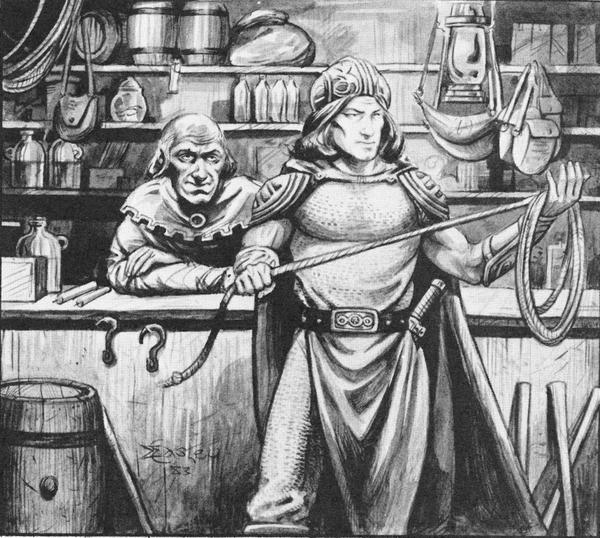
There is a Moebius image for every blogpost!

Creature companions/pets have three attributes besides their regular DMG, HD and HP: Action, Sense and Loyalty. The ACT and SEN attributes are based on the creature’s HD. ACT is 10 + HD  to a maximum of 16 and SEN is 10 + HD + (roll 2d6 and choose the lowest one) to a maximum of 18. LOY is a usage die and depends on how well trained and well treated the pet is before bad things start happening. A faithful dog that has been with the character for a few years will have LOY of d8 or even d10. A pack animal that was recently purchased will have a LOY of d4.


ACT is used for physical tests like dodging falling rocks or combat. SEN is used to notice something, track or any test that depends on the animal’s senses. LOY is tested any time something bad happens, such as the beast is wounded, mistreated or neglected when hungry. If the LOY result is a 1 or 2 on a d4 the animal will attempt to run away.


Pets and creature companions can play different roles during combat. One option is to attack independently using their ACT attribute. If used this way they risk damage from opponents if ACT rolls are failed. Another option is for them to fight with the character that owns them and add a +1 to their effective HD for the purposes of fighting powerful or multiple opponents. Pets could also harass and distract a single opponent to create an opening and allow the character that owns the pet to get Advantage on an attack. It depends on circumstances, but creativity should be rewarded.


Pets get one action or attack, the same as the characters. Their damage based on HD already reflects the results of using all their natural weapons.


Here’s an example notation of a lion that was charmed using potions and then became a pet:
ACT 15 SEN 15 LOY d8

DMG 1d10 HD 4+1 HP 18

This way all the rolls stay player facing while they roll against the stats their pets have when they take some kind of action. The loyalty die allows whoever is running the game to keep things from getting too out of hand. If the pet is being overused they can call for more loyalty rolls.

Let me know what you think in the comments. Especially if your try them out too! 


Thursday, 10 November 2016

Character Generation: How Much is Too Much?

Here's a look at my game development woes. Complications like these are part of what makes adapting something simple like Swords and Wizardry or the Black Hack to a unique setting so appealing!

While the playtesting for my 3D System is going well, I have run into what might be a snag with the character generation section. The graduated success mechanic using 3D6 that relies on the interaction of six attributes and 12 skills has turned out to be intuitive and robust in play, but the system I created to generate those attributes and skills has me worried.


For a variety of reasons, I integrated the character generation with the setting. It worked well with the small playtest setting for the Archipelago in Island Crashers. Going through the process delivered the assumptions of the setting to new players without spamming them with text they didn't want to read. It took ten minutes to create a character rolling randomly and about twenty minutes to use the generation tables like a flow chart and choose everything.

For the Island Crashers playtest character generation takes up ten pages of a google document and 35 small tables on spreadsheets. The process of moving through them is intuitive and easy. Brand new players are having no trouble with it even though no one has taken the time to read the rules first. Each area of origin has its own background that informs the basics of the character. These areas also have unique tables with some starting careers more likely than others. The tables themselves tell the player a bit about where their character is from.

Good thing character generation only takes ten minutes!
I'll use a more familiar setting to make the idea clear. Say you were using this system to play in Robert E Howard's "Conan the Barbarian" setting of Hyboria. Characters from Conan's homeland of Cimmeria would have basic survival skills they learned growing up in an uncivilised area. They also would get a boost to their physical attributes because their life makes them harder than the civilised peoples. The possible starting careers for characters from Cimmeria would include things like blacksmiths, barbarians, hunters, bandits, leather-workers and maybe druids. The kingdom Conan eventually conquered, Aquilonia, would have a table of starting careers that includes nobles, merchants, soldiers, courtiers, servants, thieves, priests and wizards. A place of ancient corruption like Stygia would have a table of starting careers filled with sorcerers, priests, sages, slavers, thieves and slaves. The flavour of each of these lands is evident in the choices provided.

That's what I'm doing with my setting for the larger game that is using the working title of: "The Last World." The problem is the Archipelago is a small cluster of islands. Even Hyboria is only an area the size of Europe and the Mediterranean! The Last World is huge in comparison, with all kinds of different areas! These areas aren't heavily defined, with the implied setting leaving room to develop them through game play, but each country and some major cities have their own tables. I'm only about a third of the way through the character generation section for the places of origin and I already have 26 pages of briefs and tables in my document. The descriptions of the playable creatures document is another 9 pages long! I haven't even started on the tables of general career progressions. I'm worried about it being unwieldy, but I want players to be able to start as nearly any creature or culture they could encounter in the Last World and move through a plausible list of careers to create a viable character with a developed past and a list of useful equipment.

Shopping for equipment is the time-killer!

The point is to create characters similar in power to what you'd find in levels five through seven in OSR-type games. Like Traveller's character generation, the process creates a competent character with a background story that makes sense. I find the most fun in old school campaigns happens around those levels, but the early levels help define the character's development and flesh out their personality. That's another reason I make a ten minute game out of character generation. It delivers setting information to new players and creates a backstory for the character that will help a player choose how to play in a way that makes sense. It also anchors them to the world with their past.

In playtest it's worked well so far, but I'm worried all the flipping back and forth thought the tables in the larger setting will kill it. A PDF could be cross-linked/bookmarked, but using a book might become unwieldy. I was hoping to get this all into an A5 (digest size) hardcover!


So how much is too much? Does it matter that there are pile of pages to flip through as long as character generation stays around ten to fifteen minutes? Do the benefits outweigh the drawbacks in any event? I feel like the only way to find out is to finish it all and play using the full setting.


If any of this stuff intrigues you and you want to be part of the larger playtest for the #3DSystem , let me know!


Thursday, 12 May 2016

Dangerous Magic in Fantasy Gaming

I started reading the Elric Saga by Michael Moorcock just before Christmas. The magic in the stories and some other things that have come up while gaming has me re-evaluating magic in fantasy RPGs.

Back in the days of 1e and 2e D&D, when I played a magic user I would bend spells until they broke. I found ways to use spells that had little to do with their original intent but worked within their description. I drove GMs nuts with my descriptions of how my characters were using the spells because they'd would constantly need to make a ruling on whether it would work out the way I wanted or not. Things like casting an Enlarge spell on a wooden door in a stone frame so it would shatter as it grew too big for the space it was in, or casting a Knock spell to unlatch all the buckles on the enemy's platemail.

The newer games have either nerfed the spells or created far more explicit descriptions that don't allow for these interpretations of effects. That's progress I suppose.

I recently found myself exercising those old creative muscles again in a Fifth Edition game I'm playing. We're well into our second year of play and my Warlock hit 9th level. That means she can summon Elementals now. When I saw that ability as one of many on the menu to choose from at 9th level I thought about the Elric stories and all the things I could get an Elemental to do during the one-hour duration.

Now I look at the abilities of the different elementals and figure out what kind of things I can do with them. The reaction of horror from the other players when my character commanded an Earth Elemental to drag an opponent into the ground and leave him there was something of a surprise. I figure a Warlock has the moral flexibility necessary to bury imaginary bad guys alive.

Between the four kinds of elementals my character can solve a lot of problems. Combat and movement are two common ones. For instance, Air Elementals can carry your character through the air and blast your enemies. So much more fun than a regular Fly spell!


I've mentioned before that I'm working on my own fantasy game system and one of the priorities I have is to make the magic system more open. To design it to reward creativity and unconventional thinking. As wonderful as that is, it's taking a long time for me to test everything and make certain the game does all the things I want it to do (like be fun to play). Not to mention that a lot of people don't want to change their game even though they might like to bring what I'm talking about to their table.

The pulps that influenced the creation of the first RPGs leave their marks on the magic systems we take for granted now but the structure keeps magic safe and largely predictable. Magic was always a bit scary in those old stories. A good example of something that they brought into the structure is the creature from Robert Howard's first Conan story, "The Phoenix on the Sword," inspiring the Invisible Stalker spell. When you read Michael Moorcock's Elric stories though, they summon water elementals to create a fog to hide their navy or fire elementals to set fire to a town when attacking. They summon terrible creatures of chaos to get secret knowledge or help navigating the different dimensions. These creatures have their own agendas and goals. Sometimes negotiation is necessary and sometimes they simply oblige.

I know that Stormbringer has a magic system that works like this, but I don't play Stormbringer nor do I know anyone that does. What I think I need is an OSR/5e D&D compatible character class that uses magic from other creatures and does no magic other than summoning and binding them to the caster's will.

Using the Magic User/Wizard class as a base, we could get there pretty quickly. For whatever system you are playing in simply adopt all the hit dice, skills, weapon and armour restrictions, etc of the Magic User/Wizard class and swap out the spellcasting for summoning and binding magic that can be used any time.

"Summoner"
This piece is actually my own attempt at drawing. I'm hugely jealous of people who can illustrate their own blogs so I'm going to try to learn to do this. If you are interested in my journey in that department or you want to see the links to the reference model you can see it at DeviantArt


This makes it easy to drop the class into whatever game you are playing without disrupting the game balance as it exists. If you are playing LotFP you get a character that can use any weapons and armour, like the rest of them but the lower hit points and lack of martial manoeuvres balances out the magic abilities. In 5e, the proficiencies and characteristics fit the flavour created by that system and its assumptions about setting.

Although for 5e, it might make more sense to use the warlock as a base for a summoner class. Once I've tested it out it would be nice to see if it would work for an Eldritch Knight. Elric was a warrior first. He only summoned elementals for large scale effects or to save him from drowning. He fought for himself.

The magic of summoning should be accessible but dangerous. Since the entities often want to get to our world for whatever reason summoning them should be easy while the real challenge comes when trying to control the creature. I also like the idea that it gets more difficult to control new entities throughout a single day. That way there's a good reason to conserve the magic and use it only when it's needed. That escalating danger is a good reason for characters using this kind of magic to be universally feared by ally and foe alike.

I already have summoning magic baked into my own game and tests are going well so far. I'll be putting together an OSR Class for summoning soon, but since I'm playing mostly 5e and playtesting my original game I'll probably do one for 5e D&D first. If you beat me to it, send me a link!


Sunday, 13 September 2015

Religious Magic in RPGs

This post was inspired in part by the contest Zak S is running over at his blog: Playing D&D With Pornstars. The Thought Eater Tournament is a series of match-ups of two writers per topic to encourage better, deeper writing about RPG topics. The first one is about religion in fantasy role playing games and is something I've thought about a lot myself. More specifically, I've thought about the source of religious magic in RPGs while designing my own fantasy RPG.


We don't need to have actual gods to have religious magic in a game. D&D and other fantasy games have a long history of making gods characters in the setting. Certainly there was plenty of inspiration for meddling gods from the stories of Greek and Norse myth. Some of the fantasy stories that inspired the original Dungeons and Dragons had extra-dimensional beings locked in a war between the forces of law and chaos that spilled over into the fantasy world. It was often expressed as a kind of dimensional cold war fought through proxies who were champions and spellcasters given extra powers by their extraplanar backers. It also mixed in the crusaders, saints and biblical stories. D&D, especially the older editions, calls back to the legends of the middle ages and invokes the Arthurian tales of chivalry and knighthood.

With such material informing the setting it's no surprise you end up with gods granting spells to clerics and special powers given to paladins. For me it's never quite sat right though.  The idea of gods showing up, messing about with human affairs and having the odd affair of their own to create demigods has a certain quality to it, but it's more like the brat pack era of Hollywood than a group coming together over a common belief. Fantasy religions are less about faith and devotion to the idea than they are hierarchies with a supreme being at the top. They are more like corporations with clearly defined goals based on the godly portfolio coming down from head office.


With freelancers like adventuring player characters it's often a kind of contract. There's give and take with the godlike creature. Some characters who deal with extra-dimensional beings, performing sacrifices, other services and advancing their patron's goals in exchange for powers are called Warlocks/Witches/Cultists and others are called Paladins/Clerics even though at the core they are doing the same thing.

There's no reason why the existence of a god needs to be settled to account for religious magic. In a world where magic exists, reality is already disrupted. It can be bent and even broken with the correct pressure. In such a world a large enough group could form a kind of psychic pressure that could be used to disrupt reality in the form of miracles and other faith-based abilities.

A large enough group of people believing in an idea gives that idea power. The more people that believe, the more power that builds behind the idea. This power might manifest randomly in miracles and other unexplained phenomena. They could be mysterious like burning bushes, epic like earthquakes and thunder, or ridiculous like the visage of the god appearing in common food items like toast. Where it becomes interesting and gameable is when there are individuals who can tap into this power provided by the belief of faithful. People who can shape the will of others into particular effects like healing or even a plague.


These conduits of the faith would be as rare or common as is needed by the setting. They could be found leading a faith, drawing on the power of the faithful to perform miracles and gather more to their religion through these demonstrations of godly "intervention." They could even begin as charlatans who are suddenly surprised by their ability to perform real miracles thanks to the faith of their flock, despite having no belief of their own. The idea that a religious leader could fake it until they make it has all kinds of possibilities. They could also be individuals operating outside of a hierarchy as chosen champions, druids leading their communities, or even hermits serving in remote shrines.

It's the champions of the faith that are the most likely to become adventuring characters and played. Powerful missionaries carrying their message into the wide world or passionate believers living as examples in the dark times. Certainly a player character might want to build their own religion or religious faction of an established church. Depending on the campaign your group is into, the intrigue and challenge of creating a new religious order might provide the best adventure hooks.

When the characters get their power in the form of spells from some deity or demon prince there's not much incentive for them to do much in the way of religious boosting. If the character's power is tied to the faith of those following the same religion there is a good reason to spread the good word.

In game terms it could break down to numbers and distance. The larger the group the more power that would be available to an individual able to tap into it. How much of that power they could access would depend on the talent and experience of a particular character though. There would need to be some critical mass to get the minimum required to perform the most basic of miracles, the cantrip in D&D for example. It could be a number with some kind of meaning or completely arbitrary. Each level of power could require a different number of believers, growing exponentially from a single village to the population of a country or empire.


The distance would come into play as the champion moved away from the centre of religious belief. As they move farther away from the faithful the harder it is to tap into the psychic power provided by the belief of the masses. This could be overcome by setting up missions and chapels as outposts of the faith to form a kind of psychic corridor back to the power base of the faithful.

The idea that the smaller groups of worshippers could connect to the larger faith and carry the signal forward to the conduit of that faith like radio relay towers. If war or change disrupted the reach of the original religious organization the new churches could provide their own faith for the character to draw on. Regardless, there's an incentive for them to convert new followers and set up churches wherever they go. Also giving them something on which to spend any treasure they happen to find. The rest of the party might be keen to chip in since the one character's ability to access the power of faith affects their fortunes as well. The amount of available power would drop by one level for a particular distance so the faith of a theocracy might be felt and used on the far side of a continent or even ocean while a village of believers might only provide useful power out to a day's ride away.

As a factor of belief the faith magic becomes more dependant on religion and the religious instead of the terms of a contract with a god-like creature. This changes the game and creates some new incentives for players of religious characters to play their role as proponents of their religion or religious order. These are the reasons I chose this direction for the system and setting I'm working on for my own game but I don't see why the concept couldn't be used for any other fantasy RPG. It's just a matter of tweaking the setting a little.

In this model of using the common belief of the group as a source of magic rather than a god or group of gods gives the GM quite a bit of latitude in defining the place of gods in the game world. Their existence could be a question that is not answered, which is my favourite but certainly not the best. They could be remote and uncaring like Conan's Crom with the worship of lesser beings passing unnoticed. They might be like Terry Prachett's Small Gods that draw power from the devotion of mortals and are even created by it. They could need the worship to allow them power in the world. Perhaps with enough believers they could even enter it. That makes the Cthulhu cults a little more dangerous if they can frighten or bribe or fool enough people into devoting themselves to the great old one it might show up!


NOTE: This is an updated version of the original blog post. The original had an unnecessary definition of faith that people were stumbling over. I'd rather people engage the premise than debate my use of an overly simplistic definition, so I took it out.


Monday, 27 July 2015

Wargaming in 3D

Dissatisfaction with the current state of tabletop wargames is something of a recurring theme on the internet. People complain about how they don't like the new rules, the obsolescence of their minis, the necessity of buying the latest spat books, how constrictive the splat books are, and other ways the hobby is set up to milk gamers for cash. A recent Google+ thread rehashed all these issues and more.

Every time the conversation starts up I'm taken back to my beginning in the hobby in the 1980s. Back then, the only thing we needed to play was the rulebook. One rulebook full of options for building armies and manoeuvring them on the battlefield for epic battles.


I started playing with the third edition of Warhammer Fantasy Battle from Games Workshop that my friends and I picked up at the local comic store. It wasn't long before the owner of the store was playing with us and then adding tables with terrain. Tabletop wargaming has only grown in Sudbury through the years since then.

When we started there were no restrictions on minis for "official play" or any of that nonsense. Any mini was a potential combatant. We used the GW minis because they were often the best available at the time but most armies included minis from Grenadier, Ral Partha and others. About the only thing holding the rag-tag forces together were fantasy race themes and uniform colours.

For our first games we didn't even use miniatures. We started out with coloured cardstock cut into bases. Even after we embraced the painting and modifying miniatures part of the hobby, it was still normal to see to cardstock minis with pictures or descriptions written on them fielded along side painted and unpainted miniatures.

Those early games were pretty wild. There were high elf armies fielding huge trebuchets, mixed forces that made no sense, and a list of other things that violated our assumptions about the fantasy setting the battles took place in. That all changed with the release of the Armies book in 1988. 


The Armies book had lists of troops that fit the theme of each race and rules for allied forces and hiring mercenaries. The flavour of the setting informed 
the rosters without throwing everything out of balance. For example, elves didn't have access to heavy artillery but they did have dragons. The restrictions gave each army its own specialities and strong points. It made the choice of forces more interesting than before. It did not stop us from using non-GW minis. If anything, our needs for cheap masses of things like wood-elf spearmen only increased with Armies book. As a joke I even fielded a tree from a train set with googly eyes stuck on it as a treeman miniature.


It feels like there were less rules back then and it made for more fun. The only real problem was the magic system. It was so random. There were spells in the lists that were battle-winners. The "Vorpal Hurricane of Chaos" could devastate an army and make it impossible to fight with anything other than long range missile weapons. 

The rules have changed over the editions. There have been so many editions of WFB and 40K, the biggest challenge when I play is remembering which of the rules in my head apply to the current game. The rules have improved a little but mainly it has tweaked things such as shifting focus back and forth from missile combat to melee combat. 

Certainly magic has gotten better since those crazy games in the 80s. I think the best version of magic was the one that used the card decks for the different kinds of magic and a power deck to represent the ebb and flow of magic on the battlefield. It made magic an important part to any strategy without allowing the game to turn on it. Almost all of the handful of spells available to a wizard would be useful. It was random without being stupid. 

Still, with the army splat books pushing the envelope farther with each release the special rules appear to escalate in a vicious circle. The last few editions have been less about improving the rules and more about wiping the slate clean to re-establish balance between the available forces.


The love affair with splat books probably came out of the success of the two Realms of Chaos books. These books are notorious for the amazing art and over-the-top craziness for content. Not buying these is my one regret from those days. I picked up Warhammer Siege which we ended up using well into the later editions, but the Realms of Chaos were something that Games Workshop never did again. They never pushed as far or as high as it did with those books. My friend had them and I read through their copies but didn't buy my own because I didn't play Chaos. Sadly, I had no idea what a rare thing it was to have dark fantasy explored so deeply and so well in game form. I could write pages about the art but it's all been said before elsewhere on the gaming blogosphere.


Despite all of the complaining, tabletop wargaming appears to be in something of a resurgence. There are more games to choose from now, with War Machine in particular taking some serious ground in the hobby. I even seen some reports of people playing H.G. Wells' Little Wars. I hear doom and gloom about Games Workshop, but the local store still sells a tonne of it and hosts multiple game nights filling all the tables so even the complainers are still playing it.

For me, what I really want is the excitement of those early games where the rules helped us have crazy fights on four by eight foot areas of carpet blocked off in chalk and covered in a mishmash of train set and fantasy terrain. I miss those loose games where fielding a model like a dragon could be a critical hard point in the battle line or an awful waste of points depending on how things came out with the tactics and dice.  I don't want to play the old game though. I still have the books but I don't want to use them because years of play has taught me a thing or two about how rules shake out at the table. My involvement with the OSR for RPGs has also convinced me that sometimes stepping back to earlier editions and then stepping forward in a new direction with the benefit of years of development can yield some awesome results.

The first time I encountered the complaining about GW was three or four years ago. I decided I could do better so I spent a few months designing a new wargame. I built in the flexibility to use a wide variety of miniatures and settings, from gonzo steampunk fantasy to historical re-enactment. That recent thread on G+ brought it back to me as something others might enjoy too. The first time I shared the playtest document I didn't have the blog as a reference point for development of it and it basically petered out as I became busy with other things.

For the dice mechanic it uses a variant of my 3D System. I always found the rolling of one die per mini (to hit and another to wound and then another for an armour save...) to be tedious. I understand that the large number of dice made chance less of an issue since the odds would wash out with more dice, but it makes for a slow game with unit fights taking too long. It means battles had to be fought between limited numbers of units if the players had any hope of finishing. To fix that I used rolls of three six-sided-dice totalled with all modifiers for each unit. One throw per side, per turn for each unit in combat speeds everything up and still mitigates the luck factor with the results curved on the three dice.

I've tested it a bit and the point spreads seem balanced so far. The rules have worked well enough for me but I haven't had much feedback from others on how their games went with it. I'm still not sure about the rules for flying creatures so I'd like to hear about how that's worked out in play for others. The magic system is pretty basic, but fits the rules-light system well. The magic makes the wizard models a flexible tactical piece that can affect the battle without turning the game in to a wizard's duel. Success seems a little difficult for larger effects though so I'm toying with lowering/removing some of the modifiers or dropping down the base target numbers for success. Again, any feedback about how it goes in play would be appreciated.

I'm attaching the link to the original playtest document. The game hasn't changed much from this original version. There's about 12 pages of actual rules here. The first page you can ignore. It's old text explaining what I was trying to accomplish with the game and contact info for feedback. The rest of it is a rough draft of the Open War Fantasy Battle game. Give it a try. Let me know about any holes or things that don't work in your games. I'm aware of the typos but I'd like know if the language is difficult to understand in any way. I had originally envisioned a pocket mod version of the game, but I don't see that happening ever. Too much detail would be lost.

So give the alpha version of Open War Fantasy Battle a whirl and let me know how it works out!

Thanks!