Showing posts with label Classic Traveller. Show all posts

Tuesday, 22 May 2018

Review: UVG - the Ultraviolet Grasslands and the Black City

With all the awesome things released this year it blows my mind that one I will use first is both free and, according to its author, incomplete.

Luka Rejec released an introductory version of the "Ultraviolet Grasslands and the Black City" last week. It's a 78 page point crawl with only one location fleshed out. According to Luka's Patreon, the complete version will be released in August of this year. While I'm looking forward to it, this teaser version has plenty to offer.

The cover by Luka Rejec


At long last, WONDER!

I downloaded UVG for the artwork. Luka's work has a way of expressing a great deal of detail and movement with a few simple lines. It reminds of the work of Jean Giraud, A.K.A. Moebius, while showing me something new and original. His work carries a sense of wonder and the fantastic while not settling in any particular genre. I am a fan.

"The Rusty Arc" by Luka Rejec

The Ultraviolet Grasslands leans into this same aesthetic. Luka is is upfront about the influence of the Dying Earth and psychedelic heavy metal on the setting/adventure. The sense of an ancient world, full of sorcery and super-science haunted by the, "long ago," is carried through the adventure's descriptions of the rotting technological remains, strange locations and local inhabitants. 

The new creatures and cultures introduced by the book add to the strangeness with a light touch. Each group, from humans to para-humans, has a brief description and then a table of rumours you can build your campaign's version of them from. Randomly generating the true and false features of these para-humans helps preserve that sense of uncertainty in the unknown and doubles down on the exploration theme of a fantasy RPG. It reminds me a bit of how Traveller's 76 Patrons was set up with a single premise or set of characters with multiple details on a table under each. It allows for the whole thing to be used more than once and be surprising for both the referee and the players.

UVG captures the wonder that the small press RPG community seems to be reaching for recently. It is exactly what I've been looking for. Judging by the sudden addition of Patreons since last week's release, I'm not alone.
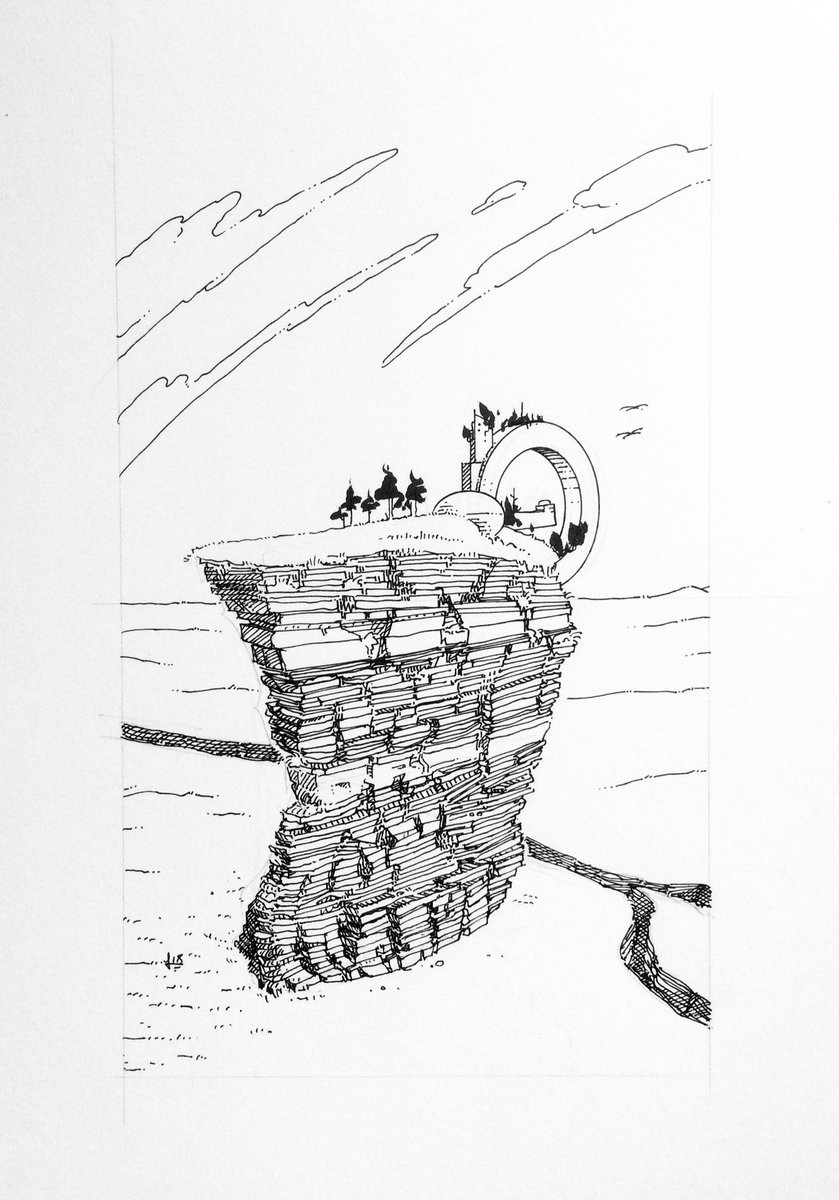
"Tower and Hill" by Luka Rejec


Innovation!

It seems like almost every notable small press RPG release from the DIY D&D and OSR communities has some sort of game-changing innovation. UVG certainly delivers in this area. Luka created some new rules for travel which simplify encumbrance and travel while still making them work in a new way. His ambition was to convey both the vast size of the adventure area and the danger of travel through his weird savanna. I'll know for sure once I incorporate it into my regular game, but from reading it, I'd say he succeeds. Besides that success, he also creates a rules-light system for speculative trade that reminds me of Classic Traveller. The simplicity of Luka's system gives the players real choices about how much cargo to carry versus supplies, how large to make their caravan, and even what form of transport and retainers to use. All of these choices have an impact on the speed of travel, potential for encounters and even the likelihood of starving to death. Things like caravan speed and visibility also change the chances of starving and having an encounter.

Hacking up Treasure for UVG - Luka Rejec

I like the switch from days as a unit of time for travel to weeks. It helps to create the sense of isolation in the wilderness when there is only one encounter rolled per week. The party is on its own so they better have what they need. 

Because space and weight are issues that can kill a party, treasure can't always be hauled away with ease. Because of this feature, there are rules for hacking up the treasure for the best bits. This form of looting does terrible damage to these finds, turning the party into vandals, but it allows them to make choices about how they want to deal with large pieces of treasure.

While the UVG is a sandbox filled with all kinds of creatures and points of interest, the distance is the biggest enemy that needs to be faced. I enjoy this feeling of the vast openness as an opponent and can do a lot with it. It certainly marks this adventure as something special and reminds me a bit of how the darkness is handled in Veins of the Earth.

I like how once there is trouble, or something to explore, we return to shorter time units, from days for starvation, down to seconds for combat. It's a way of narrowing the focus and placing the players into the context of the current size of the environment they are interacting with. I'm looking forward to saying things like: "Four days into the second week you see movement on the horizon..."

Luka Rejec's Caravan Record Sheet for UVG makes tracking the new important bits easier!


How does it work?

Luka describes it as a rules-light, RPG point crawl and it is that, but it is clearly set up with some version of 5th edition D&D in mind. The saves reference the six classic statistics. Also the rolls for success use a roll high verses a ladder of target numbers. 

I tend to run a heavily modified hack of the Black Hack so the stat-based saves fit in fine, but the progressive target numbers are a bit harder to work with if you aren't using a skill system. The easiest thing seems to be dividing the stat by three and adding it to the d20 roll, but the most accurate might be to compare how much the check against a stat is made or missed by to the target number ladder. Someone using LotFP might want to multiply skill pips by two and add that amount to the d20 roll.

Despite the few 5e-isms built into the system most things are designed for cross compatibility. Encumbrance and movement rates are simplified when translated into a weekly turn system. All prices are in "cash" so it doesn't matter if you are using a gold piece, silver piece, or tic-tac as the main currency. All the creature and transport descriptions are expressed in terms of hit dice so they will work with any of the D&D editions or clones with minimal work. The weird weapons and items work with minimal conversion as well. 

Another Point of Interest in UVG - Luka Rejec

Basically the innovations are rules light and completely compatible with any system, while the details like weird weapons and armour are mostly expressed in terms of the 5e D&D rules with ascending AC for the armours and weapon terms such as, "finesse," and, "versatile." Any DM/referee using a stripped down "O5R" style rules will not need to convert anything. For the rest, it can be converted or ignored as usual.

The point crawl itself has a series of destinations arranged on the map with the different routes between them marked in how many weeks it usually takes to travel them. There are also spots for placing or generating, "points of interest," near the destinations or off the routes that the party might want to spend some time investigating. These points of interest are investigated in days instead of weeks. There is one sample, but no random generator for the points of interest. You'll need to create those on your own. I expect the full version will have more.

In this introductory version of the UVG, only the first destination, the Violet City is fleshed out. The rest are given a paragraph of description that is enough for anyone looking for inspiration, but leaves a lot of work for the referee to detail. The other locations are available to Luka's Patreon contributors up to #22, The Cage Run, but more are being added all the time. I like it as is. The paragraphs give me enough to work with that I can add details on the fly or make a few tables to generate some points of interest. I might even cannibalize LotFP's Carcosa for some points of interest and other terrors left over from the, "long ago." 

Point of interest from the "Long Ago" - Luka Rejec


UVG! What is it good for?

The sandbox can be used whole hog as described in the adventure and there are plenty of hooks to entice a wide variety of players to enter the Ultraviolet Grasslands. That's my plan.

The rules for hacking up parts of treasure for encumbrance reasons are going to be part of my campaign from the next session onward! 

UVG's rules for overland travel through what is essentially a desert are great! I'll be rolling those into my normal game for long distance travel. The simplicity and presentation of important choices to the players are the perfect tool for me. I may make some modifications for water-based travel so I can keep everything consistent. A new obstacles table is the first thing to create, but the UVG one is a great model!

The rules for trade and even market research could be used in a seafaring campaign or other trade-based adventure. If you spent a long time creating a vast world full of vibrant detail, or you spent a lot of money on supplements of the same, the trade and travel system might be a way to get the party moving around the map so you can use more of it. 

The Para-humans of the different factions in the UVG can easily be lifted and dropped into any fantasy world. There's no reason why the Cat Lords or Porcelain Princes can't be secretly be in charge of Vornhiem, Calimport, Lankhmar, or any home brewed city. 

The art is fantastic and could inspire a kick-ass campaign on its own! Knowing that the art would be awesome is a big part of why I took the time to check this intro UVG out! Without it, I might have waited for the finished product.

Final Thoughts

For a teaser product, the intro version of the Ultraviolet Grasslands is surprisingly complete and usable. The table of contents makes it easy to find specific information. The layout is clean. There are caravan tracking sheets that are well designed to be compatible with the system for the sandbox setting. The point crawl map is made to be printed, written on and used at the table. It is designed to be a tool and I can see it working well for me. The tables for obstacles and bad happenstances are nice details as well. The example of the Violet City is a fine template for fleshing out the other destinations. For a free product, I could not ask for more. It's more than a lot of referees will ever need to run a long campaign. 

It's barely referenced, but elves appear to be an affliction in Luka's campaign that infects the half-elves and turns them into tree-hugging monsters. I have my own horrific version of elves, but I'd love to know more about these ones!

I'd love a little more information about the purple mist. I may have missed it, but other than its change to the sunrise I'm not sure what it does. 

Did I mention the art? The art is great! I printed it out as an A5 booklet in black & white and it all looks great! The muted colours in the PDF set a wonderful tone and help create the feel of the sandbox setting for the adventure.

Even though I'll be incorporating the intro version of UVG into my campaign as a location as soon as I can, I'll definitely pick up the full version once it's available. Hopefully there will be a print version of some kind. Luka's ideas are different enough from mine to add a lot to my game, but still close enough I can use his work with almost no changes. I can just drop the Ultraviolet Grasslands onto the western edge of the map and start giving my players hints and hooks.

There are plenty of NPCs in UVG!


How to get UVG and more from Luka!

If I've peaked your curiousity, there are a few places to go for more: 

You can find the intro version for the PDF on Drive Thru RPG here. I printed it out as a half-letter sized booklet on a laser printer and it works great at that size. I'm torn on my expectations for the size of the final product. I am hoping the final product is A5 for the ease of use at the table, but I also want it to be A4 so the art is bigger!

There's more information on Luka Rejec's Patreon. You can get access to more detailed descriptions of the destinations by contributing as little as a dollar to the patreon. I expect I'll be sign up myself, now that the review is done.

If you are interested in seeing more of Luka's work, his website for his art and writing is here. He has a "rough portfolio" of art here. His art is also featured on his twitter here, and on his Instagram here.


Wednesday, 9 August 2017

#RPGaDay 2017 - Day Eight

What is a good RPG for a two hour session? There's plenty of micro games and pocket mods that could fill a short session with some crazy fun, but I think one of the best games for a complete game in two hours is Classic Traveller.


I know I said Classic Traveller is game I wish I was playing in the Day One Post, but that's not why I think it's perfect for two hour session. I've played quite a few two-hour sessions and with Classic Traveller using the 76 Patrons adventure book.

76 Patrons is basically 76 adventure hooks with important features randomized on a D6. It could be a twist, a betrayal, a change to the maguffin. It doesn't matter, it means there are 76 times 6 (456) potential scenarios in that little black booklet. Each page has enough information laid out to improvise a good adventure scenario. They can be completed by a motivated group in less than two hours unless the GM pads them out with extra detail or complications.


Traveller itself allows for pretty much any kind of play. The galaxy is consists of endless isolated planets full of mystery and opportunities. The party can encounter any level of tech imaginable so there is no itch that can't be scratched in a short game.


Making characters in Classic Traveller can take a few minutes and be recorded on an index card. Despite this speed and brevity, the characters are amazingly fleshed out with a storied past and plenty of experience (or skills) to bring to bear on any situation. The six stats run from raw talent to education and social standing. This and a smattering of skills give the players everything they need to figure out how their characters fit into a pulp adventure, a careful exploration, a political intrigue, etc.


If you want a quick game, the core books from Classic Traveller along with the 76 Patrons supplement will get you a short evening of fun and adventure!


Tuesday, 1 August 2017

RPG a Day 2017: Day One

It's #RPGaDAY time again. I participated once before by covering all the topics in one giant omni-post. This time I'm going to try to do the challenge as written. One RPG topic a day, every day, for all of August.

Day One is the question: "What Published RPG do you wish you were playing right now?"

Spoilers!

At the moment my gaming life is pretty rich. I play in a regular 5e D&D game. I'm playing good old Marvel FASERIP with my longtime group. I'm also running a streamlined version of the Black Hack for my kids and some of their friends. There's not much missing, but I do have a game I'd love to be playing right now: Classic Traveller.


I blogged about Classic Traveller once before. Since then the game has grown on me. It is a brilliant bit of design! It's a simple, skills-based system that makes science fiction adventure easy to do.

I like the way the loose, implied setting can be adapted to any idea the group has for the kind of game they want. It's easy to take inspiration from so much of the genre to build your setting or add detail to the implied setting until it feels right. That's why I love the original three little black books. In them, the galaxy represents infinite possibility. Anything can happen out in the vastness of space! There are dangers, opportunities and adventure out there with no reason to ever stop.


Traveller characters are experienced adventurers with the right stuff. That means the Traveller character generation is a process of creating a past for each character. This approach is brilliant for science fiction where character knowledge and experience are the tools used to overcome obstacles.

A lot of chaff is thrown at the possibility of Traveller characters dying during character generation, but it turns the process into a game in itself. A gamble with the highest of stakes! Push things too far, and that character that you are starting to like might wind up dead! Don't go far enough and you won't have the skills you need to survive in play! It's also fast enough that starting over is no huge burden. There are even some great online random character generators out there that allow you to make a character (sometimes even a dead one) in seconds.


There are piles of classic books available, but the game I want to play is in the 3 LBBs, Charts and Tables, Citizens of the Imperium and 76 Patrons. That's my dream set for the long Traveller campaign I haven't played yet.


That is why I want to play it so bad! I found Traveller only a few years ago, when I bought the charity bundle. So far I've only had short runs and one-shots with the game. Just enough to let me know how much I like it and what I want to do with it. I know I want a crumbling galactic empire, like in the Foundation Series, mixed with the oppressive regime desperately clinging to the remains of power like Blake's 7, mixed with the wild sci-fi adventure tourism of Doctor Who, all held together with the cynical opportunism of FireFly. The Traveller umbrella can cover it all and more!


Saturday, 26 September 2015

The Problem With Damage In RPGs

Role playing games feature many kinds of conflict but physical conflict is nearly always a big part of the game. With that comes the problem of tracking damage to Player Characters and its effects. I haven't written much about the system I'm developing here on the blog, but now that I'm ready to playtest the "3D System" that's going to change. Here's a look behind the curtain at my reasoning for how I dealt with the problem of damage in RPGs.

D&D and many of the games that came after it use the idea of: "Hit Points." A character or creature can take a certain amount of damage before it's mortally wounded and goes down/dies. Hit Points as an abstraction of a character's survivability causes some confusion since it's tied to weapon damage. The concept is more of an expression of script immunity and games like Neoclassical Geek Revival are more explicit about it by calling them luck points instead.


Hit Points as a concept are illustrated by the typical action hero movie. Action heroes take a tonne of punishment over the course of a typical film. They are banged up, bruised, cut and bleeding all over, but never seem to loose their effectiveness as bad-guy-killing machines. Sometimes a particular wound will have some kind of dramatic effect for a while, such as John McLean's feet cut up by the glass in Die Hard, or Jack Bauer's heart being stopped during torture in one of the 24s. Even these consequences for critical hits are not permanent, resulting only in a quick bit of first aid or an ill-timed, dramatic nap. As characters "level up" in an RPG of this type they gain more ability to stay in the story despite the negative impact of opposing forces. Basically, they are allowed to be heroic longer and have bigger adventures. It's only that last swordstroke that really gets through the character's defences that actually connects in a way that matters. The one that brings the characters down is the mortal blow that can put a character into coma or a fight for it's life.

The Fifth Edition of D&D embraces this model by allowing characters to recover some Hit Points merely by taking a break to rest and recover and get them all back with a good night's sleep. Barbarians of Lemuria is similar, allowing the recovery of half of what is lost in a combat merely by taking a break to have a drink and rest. If Hit Points are just a matter of staying power and not actual serious wounds, they should be easy to recover.


My favourite part of 5e D&D is the fight for survival after losing all Hit Points. Rolling saves to either stabilize in unconsciousness or die without help show how deadly that last hit was. Old D&D countered the massive hit points with some things like poison and magical effects like a Medusa's stare coming down to a single roll to avoid death. Fail that saving throw and the character is dead, no matter how many Hit Points they had. Even the greatest hero could be killed by a serious threat. A poison dart was all it took to kill Achilles after all.

Playing big damn heroes is fun, so this abstraction works pretty well for a lot of games but some of the genre fiction that these games are based on takes a grittier approach. The idea that you could take a beating and still be as effective as you if were fresh also requires more suspension of disbelief than some people want in their fiction or games.

Some games stick with the hit point approach and limit them to keep things tense. Games like Talislanta and Barbarians of Lemuria have hit point values for characters that allow the character to handle a few hits, but there is no expectation they will ever be tougher than that. Traveller, which I talked about in a recent post, uses a random physical stat as a stand in for hit points. These values are pretty low compared to the damage that can be done so combat is over quickly, usually going to whoever surprises their opponents. It also makes combat in Traveller a deadly prospect that players will want to plan with care. In these cases every combat has the potential to be the last one but there's no expiration of the characters like you get with the hit point model.

At least as characters run low on hit points the players become more wary and don't want to commit to a fight they might lose. Even the highest level characters are slowly run down by a succession of combats. This change is a way of mechanically expressing the exhaustion caused by life-or-death struggle and the change in play to a slower, more careful pace is representative of the effects of exhaustion without having a direct mechanic for endurance. It's also why the Constitution stat in D&D is used to modify hit points. The healthier you are the more staying power you have for fights, adventures and shenanigans.

(One of Frank Frazetta's many paintings of Conan)

Hit locations are sometimes used to create effects from damage beyond coma/death so characters could lose the use of an arm or leg and have penalties to actions instead. I find that annoying to track for NPCs and it gets even more silly than hit points when the luck of the dice spreads the damage of lighter hits across all the locations for no effect. This one has always felt fiddly to me and never worth the effort to track.

Hit points are a nice simple solution to express a complex situation. Even when people don't understand how much is going on it still works as a game mechanic. As much as I like it in D&D and other games, I don't want to use it for the one I'm designing. Because my game embraces the pulp feel where heroes are worn down but still succeed, I decided to make damage an increasing penalty rather than a ticking clock.

Part of the inspiration came from reading Robert E. Howard's Phoenix on the Sword [Spoilers! this paragraph only] in which an older Conan is set upon by a group of assassins.  Because he's Conan, they can't get around his defences to land a definitive killing blow, but they do wound him making it impossible for him to do much more than defend himself. As the minor hits and cuts pile up he slows down and becomes more vulnerable. It is an awesome fight with great tension! It would be so much fun to play that way! As damage makes the fight more desperate players get creative to end it quickly. When that happens it's more fun for me whether I'm playing or running.

The old D6 System from West End Games had a wound track with increasing penalties. This method worked great for the cinematic action they were going for with games like the original Star Wars RPG.  There are other games that use wound tracks and some of them integrate them into the game exceptionally well. Mouseguard is a great example. I have a lot of love for D6 Star Wars though, and the more I think of it, the more I realise it may be game that gave me the subconscious push in that direction when I was deciding on the damage system for the 3D System. The pace of the game and the pulp-cinema swing of the action are things I love in a game. I've said it before, D6 Star Wars only needs little tweaking to be a sweet sword and sorcery game itself. Based on the pedigree of the wound track, I'm confident it will fit the feel of the play I want at my table.

My take on the wound track is pretty simple. Humans and their equivalents have two boxes in their tracks that correspond to Wounded and Down similar to the Wounded and Incapacitated statuses in D6 Star Wars. In the 3D System each box ticked means another -3 penalty so that Down character is rolling -6 to do anything and is more likely to push too hard and wind up dead than succeed. Other creatures will have different tracks but this model is the character kind of resilience.

The wound track is not enough though. It still doesn't catch the flavour of the fight in The Phoenix on the Sword or the other pulp fiction I'd like my games to feel like. That's why I added minor hits. These light wounds are the flesh wounds and bruising that can be shaken off or ignored with a little rest and quick medical treatment. These cumulative -1 penalties can build up in a fight and make it hard to continue a fight without ever threatening the actual life of the character. First blood is a serious advantage.'

"It is but a scratch"

The difference between wounds and minor hits is the size of the penalty (-3 vs -1) and speed in which they are recovered. A proper wound will take time to heal whereas a minor hit can be recovered from with a roll after some rest and possible medical treatment. Rolling to recover means some of these light wounds will persist in hampering the character's ability. The timeline is tight, and it means the characters can continue on, but fate will catch up with them eventually if they push things too far. This system blends the grittiness of low hit points and would tracks with the limited endurance of the hit point system.

From what testing I've done in scenarios for my #3DSytem, it looks like will work. We'll see how it plays soon enough. There's no perfect solution to RPG damage, but I'm hoping this one works out for my gaming style.

UPDATE/NOTE: In playtest the wound track created a situation one of my players dubbed the "death spiral" where the advantage gained by one side or another allowed them to push the loser into ineffectiveness quickly. That turned combat into a situation where the two sides fought for the upper hand and once it was secured surrenders started. In one case a character that was wounded stepped away from the combat and tried to help in some other way because they were too wounded to continue.

I enjoyed the moment to moment consequence and the way it changed the flow of the game from the abstract hit point style combat. I've rarely seen surrenders happen in D&D because the bad guys might be only one HP from defeat. No one wants to give up. Because the flow of the fight is obvious to everyone involved, the fight to the death is becoming less likely in the 3D System.

Tuesday, 8 September 2015

Classic Traveller: Playing for the First Time!

Our Classic Traveller campaign is still fresh at one month old, but my wheels are spinning in my brain already!

I'm enjoying it so far. This little game is a tonne of fun! I was fortunate that our group decided to play Classic Traveller around the same time the charity Bundle of Holding put the majority of the books together for download at a huge discount. One of the beautiful things about the, "little black books," is how economical it is to print them out in A5 booklets on a typical office laser printer. I printed out a pile of books just to read them!

(Why yes, I did colour in the margins of the covers with a Sharpie. What of it?)

It seems a strange thing that I didn't play Traveller in the early 80s when I was starting to play so many other games, but the world was a much larger place back then. I lived in a city that could be best described as "remote" at the time. Without the internet and the new divided highways that connect us to the major cities in the south nowadays, we took what we could get up here. As far as RPGs went there were the TSR boxes in the Sears department store, the tiny collection of dice, modules and AD&D books at the hobby shop and a shelf at the comic shop located in the downtown core. Traveller just never made it to Sudbury. For science fiction RPGs we had Star Frontiers and eventually GURPS Space, but Traveller was a game I merely read about in Dragon. I played a myriad of sci-fi RPGs over the years, but Traveller continued to elude me.

After I joined the RPG enthusiast party that is Google Plus I heard more and more about Traveller and how awesome it is. It became something of an RPG bucket list item for me so I'm thrilled that we finally played it in our infamous Tuesday Night Hangout Game!


We decided to use the classic version of the game. The one that originally came as three, "little black books." Since the only one of us to play Traveller before was our GM he elected to keep it simple with the original game and only the basic books.

Those three books are a complete mess. They make the game harder to play than it needs to be. Don't use them. Seriously. The original books from 1977 are 'organized' along the similar lines to the original D&D, "little brown books," with one for characters and rules, another for starships and space rules, and the final one for world and adventure building. They look like they were typed out on a typewriter and cut and pasted together (which they probably were). There's no art and the layout is awkward at best.

(For the love of sanity, don't use these books!)

The good news is the game was re-released in a "starter box" in 1981 with a new layout and books separated into the core book, all the charts and tables, and the adventure book to get a new GM started. Arranging the rules in one book and referring to the reference book for charts makes gameplay a much better experience. Our group has already switched to the starter set. If you are new to Traveller, do yourself a favour and start there. The art certainly is typical of its era, but at least it breaks up the text and shows you what the standard designs of ships look like.

(Use these books instead. Trust me.)

What I love about Traveller is the scope of it. The universe is a vast sandbox of worlds where anything can be happening! The rules of space travel make communication a matter of going to a place with the news as cargo with weeks of time spent travelling in hyper/jump space. This means worlds can be lost. Wars are slow and devastating. Opportunities abound for the people who have managed to be at the right place at the right time.

Fortune favours the bold.


The implied setting is in a massive galactic empire that is preoccupied mostly with defence and commerce. The individual worlds and small collections of system are left mostly to their own devices in the vast bureaucracy that is the Imperium. There's plenty of room for adventure in such a place, doing freelance missions for Imperial intelligence, operating as a tramp freighter moving cargo from system to system on speculation, explorers searching for lost technologies from a forgotten age, couriers bringing sensitive information and packages to clients with discretion, finding opportunities for high risk cargo transport (smuggling), salvage teams/pirates taking what they can from the space lanes, power brokers getting involved in planetary politics, mercenaries doing the jobs that patrons need to keep some distance from, bounty hunters bringing in dangerous people or even kidnapping innocents... there's no limit!


There's a lot in this game that feels like the gritty sci-fi of the late 70s and early 80s. I can see the influence of Blake's 7 here and there. The movie Alien could be a Traveller adventure. So could the sequel Aliens for that matter. The psionics section looks like it is lifted directly from scripts of The Tomorrow People. With these rules I could even turn the old Canadian sci-fi classic The Starlost into a campaign.

Part of the beauty of the system is how well it has kept over the years. It still seems like a great RPG to run something like Farscape, Cowboy Bebop or Firefly. There are plenty of rumours on the internet about how Firefly is based on Joss Whedon's college Traveller campaign. It certainly translates well and the idea of it shows how a GM is not bound by the implied setting. It can be taken down to a single star system full of inhabited/terra-formed worlds clustered together in an almost clausterphobic proximity. Take away jump drives and you are back to the same age-of-sail speed of game. There's no reason to have a successful Imperium either. It could be crumbling like the last days of Rome or Asimov's Foundation series. The coming chaos creates opportunity for adventure and the necessity to search for older, better technology!

So far our game has a Firefly/Cowboy Bebop vibe to it. Playing morally flexible opportunists out in the far reaches of space is pretty sweet. Turns out we are not bad at crime. Not so good at mutiny or stealing ships, but low-violence crime is definitely our bag.

(everything I needed to fall in love with Cowboy Bebop is here in the opening credits)

That's a lot to say about the fluff for a game that is not terribly attached to the setting! There's plenty to say about the crunch too!

Crunch in the far future...


People talk a lot of crap about the character generation system and how you can die while making a character. Traveller characters are experienced, capable people. The character generation is a process of rolling up the experiences that made them that way. Not everyone makes it. Push it too far, stay in a dangerous service too long and your character is dead. The risk makes the reward sweeter and the whole process a lot more fun. There's an old joke about D&D that backstory is everything that happens before level 5. In Traveller you just roll all that nonsense and move on. Some characters don't make it to level 5 in D&D, so it goes in Traveller. If you get lucky with your stats survival is pretty easy. We haven't lost any characters during character generation yet. A couple of us had to make new characters after our first ones were blasted out of orbit by the authorities though. That was a rough lesson.

Combat is deadly! It is resolved after only a round or two. You don't want it going past that or someone on your side is going down. It gives the whole thing a pulpy, old-school feel.

(Poor Blake, maybe that surprise roll is important after all)

The basic mechanic for the game is a modified 2D6 roll for a target that is almost always 8+. The roll is modified by skills and occasionally exceptional stats. For our group success comes pretty easy when rolling two dice and adding one or two to the roll to get eight or more. Statistically, it is hard to fail as long as your characters are performing a skill they are proficient in. There's a -3 penalty for non-proficiency which is devastating on the 2-12 spread. This system reinforces the idea that you assemble a team of competent specialists to get things done. If your characters try something they don't know how to do they need to get lucky or it's not going to happen. Even rolling with zero bonus the odds are stacked against you. The simplicity of the system and the way it supports the basic assumptions of the game is elegant. I get why people who played it back in the day preferred Traveller to the mish-mash of different rules and resolution mechanics that was (and essentially still is) D&D.

("I make navigation look good.")

It's the little details that make this game feel like it could happen. For example, the ship a group is most likely to have is the Scout/Courier. A small ship designed for long distance jumps with a little room for special cargoes it's an obvious choice. The fact that one of the characters is likely to have one as a benefit of their service is important too. This ship has a weird thing about it though. The air filtration is a little wonky and the whole ship begins to smell like ass after a few weeks. There are quick fixes and expensive solutions, but the end result is the GM needs to track smell along with time for this starship. I can see the workhorse of the imperial fleet ending up smelly because some planet-bound bureaucrat decided the extra tonne of cargo was more important than the air quality.


The only thing I felt was missing from the starter rules is options for careers outside of the military or merchant services. There's just "other" as an entry that seems like little more than an interplanetary vagabond. I was thinking about writing up a set of six options to replace the single "other" option on the enlistment chart. Turns out there's already a book with 12 options already made up! I found out about The Citizens of the Imperium supplement on a G+ thread and purchased the PDF right away. It's not the all the same choices I would have made but there's no reason why I can't add to it. It certainly does the job of filling out the character options.

There are some wonky rules I'd like to see tightened up. The skills for combat are silly and inconsistent with the other skills. You have a skill for engineering to cover all work on drives and such. You have a skill for electronics for all electronics stuff. If you have a skill in flying fixed-wing aircraft you can still fly a helicopter at one less than your skill with planes. That's all well and good, but for some reason there is a separate skill for revolvers and automatic pistols. There's also separate skill for broadswords and cutlasses. All characters are assumed to have a zero level skill with all weapons so at least they aren't rolling at -3 with a weapon almost exactly like the one they are skilled with.

"It is my very favourite gun."

As a GM I'd hack that into weapon groups: Pistols, long guns (shotguns, carbines and rifles), automatic weapons, black powder weapons, laser weapons, pole-arms (including spears and fixed bayonets), short blades (daggers, knives and blades) and long blades. All of these are different enough to require a different skill. I might use the familiarity (one less than the similar skill) from the flight skill with similar weapons like short/long blades or similar firearms. We'll see.

I'm excited about where our Traveller campaign will take us. There's certainly nothing in this rules-light game holding us back at this point! I can't seem to shake a feeling of foreboding for some reason though.